Home › Guide › Common Mistakes
Military Time Common Mistakes (and How to Avoid Them)
Dropping the leading zero, adding 12 to noon, saying “thousand” instead of “hundred” — five habits cause almost every military time error. Here is how to spot each one and fix it.
📖 Guide ⚠️ 5 Big Mistakes ✅ Simple Fixes
QUICK ANSWER
The most common military time mistakes are dropping the leading zero, adding 12 to noon, mixing up midnight and noon, changing the minutes, and saying “thousand” instead of “hundred”. Almost every error comes from one of those five habits, and each one has a simple fix.
The most common military time mistakes are dropping the leading zero, adding 12 to noon, mixing up midnight and noon, changing the minutes, and saying “thousand” instead of “hundred”. Almost every error comes from one of those five habits, and each one has a simple fix.
If you already have a time in front of you and just want the right answer, Military Time Converters will convert it instantly. If you want to understand why people get it wrong, and how to stop, keep reading. We’ve grouped the mistakes by what you’re doing: writing, converting, speaking, and working across time zones.
Quick Reference: Spot the Military Time Mistake
Before the details, try this. Each row shows a real-world error, why it’s wrong, and the correct version.
|
What You See |
What’s Wrong |
Correct Version |
|---|---|---|
|
800 |
Missing the leading zero |
0800 |
|
1800 PM |
Military time never uses AM or PM |
1800 (or 6:00 PM) |
|
2400 for noon |
Noon never needs 12 added |
1200 |
|
1200 for midnight |
Midnight is zero, not twelve |
0000 |
|
1:30 PM written as 0130 |
Forgot to add 12 for PM |
1330 |
|
1430 read as 2:50 PM |
The minutes never change |
2:30 PM |
|
“One thousand hours” |
Say “hundred,” not “thousand” |
“Ten hundred hours” |
|
“Zero five hundred thirty” |
Drop “hundred” when minutes are present |
“Zero five thirty” |
|
1900 read as morning |
Anything 1300 or higher is PM |
7:00 PM |
If any of these surprised you, you’re in good company. The rest of this guide explains each one.
Mistakes When Writing Military Time
Military time looks simple on paper, which is exactly why small writing slips go unnoticed.
Dropping the Leading Zero
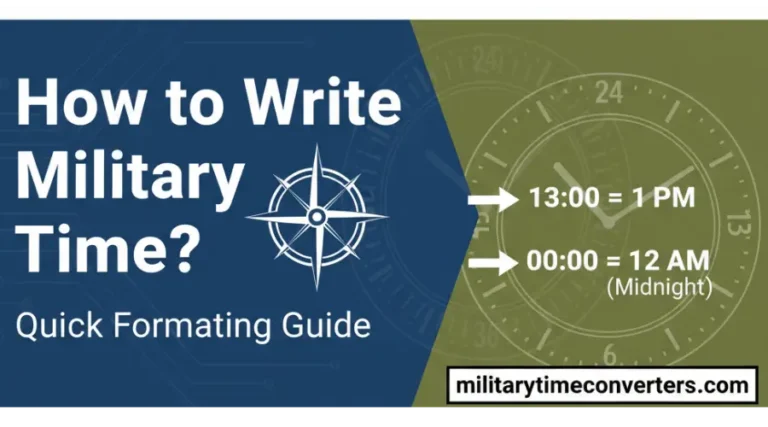
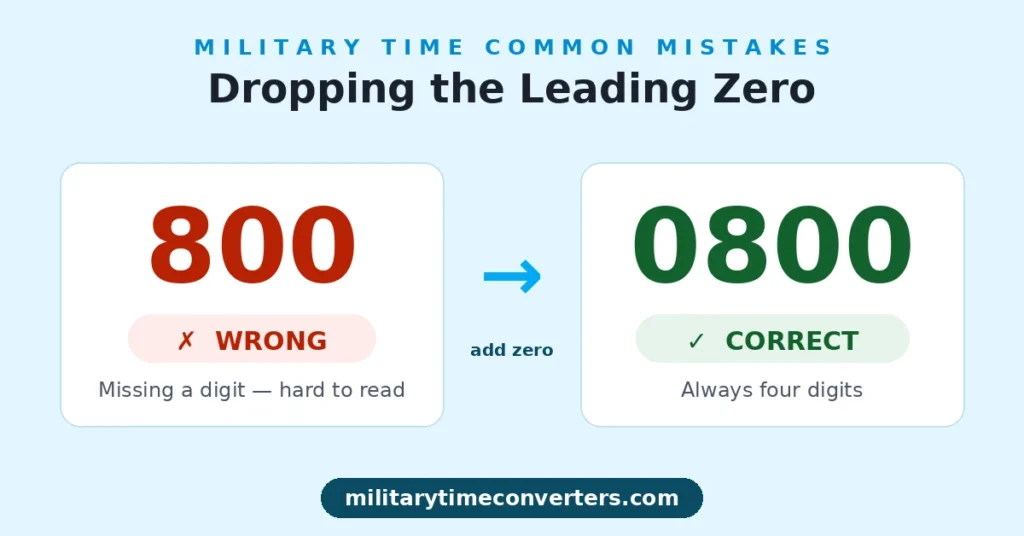
Military time always uses four digits. That means 8:00 AM is 0800, not 800, and 9:15 AM is 0915, not 915. Leaving off the zero makes the time harder to read, and in a log or a schedule, “800” can easily be mistaken for something else.
The zero matters most for early hours. You can see how it works on our 0800 military time page, and our 0900 military time page covers the last hour that still needs one. After that, from 1000 onward, the hour already has two digits, so no extra zero is needed. Our full guide on how to write military time covers every formatting rule in one place.
Using a Colon or AM/PM
Two habits slip in from the 12-hour clock: adding a colon and adding AM or PM.
1800 PM — Mixed Systems
AM and PM are never added. “1800 PM” mixes both systems — the number already tells you it’s evening.
1430 — Military Style
Four digits, no colon, no AM/PM. A colon version like 14:30 is the civilian 24-hour style — same moment, written differently.
Colon: Military style is written without one, so 2:30 PM becomes 1430. A version with a colon, like 14:30, is the civilian 24-hour style. Both mean the same moment, but they aren’t written the same way. Your phone’s 24-hour setting shows the colon version, which we explain in our guide on how to set your phone to military time.
AM or PM: These are never added. “1800 PM” is a mix of both systems. The number already tells you it’s evening.
Writing 2400 When You Mean 0000
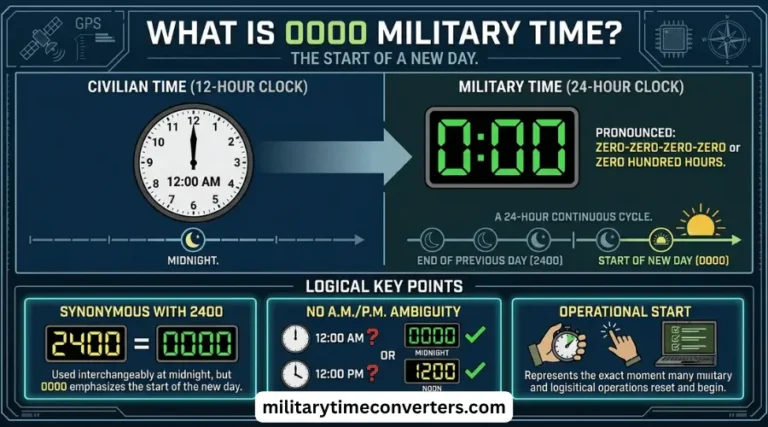
This one causes real debate. Both 0000 and 2400 point to midnight, but they’re used differently. 0000 marks the start of a day, while 2400 is sometimes used to mark the end of one. Wikipedia’s 24-hour clock page notes that some bus and train timetables show 00:00 as a departure time and 24:00 as an arrival time, and the National Institute of Standards and Technology explains why contracts and schedules use this distinction to avoid confusion about which day an event falls on.
The practical advice: use 0000 unless you’re writing an end-of-day timetable. We break the full difference down on our 0000 military time and 2400 military time pages.
Mistakes When Converting Military Time
Most military time conversion mistakes happen at exactly two moments: right at noon, and right at midnight.
Adding 12 to Noon
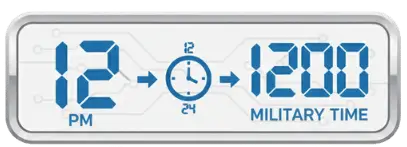
Many people learn “add 12 for PM” and then apply it to everything, including 12:00 PM. That gives 2400, which is wrong. Noon is 1200. It’s the one PM hour that needs no math at all. Our 1200 military time page walks through why, and our 1300 military time page shows the first hour where the real subtract-12 rule begins.
12:00 PM → 1200
Noon Is the One PM Hour With No Math
“Add 12 for PM” stops at noon. 12:00 PM is 1200 — never 2400. The adding-12 rule only applies from 1:00 PM onward.
Mixing Up Midnight and Noon
Midnight is 0000 and noon is 1200, twelve hours apart. The mix-up happens because standard time labels both as “12,” which is confusing in its own right. A simple memory trick: zeros mean the day is just starting, twelve means it’s the middle. If you want a full side-by-side look, our military time chart shows both at once, and you can download the printable PDF version for your desk.
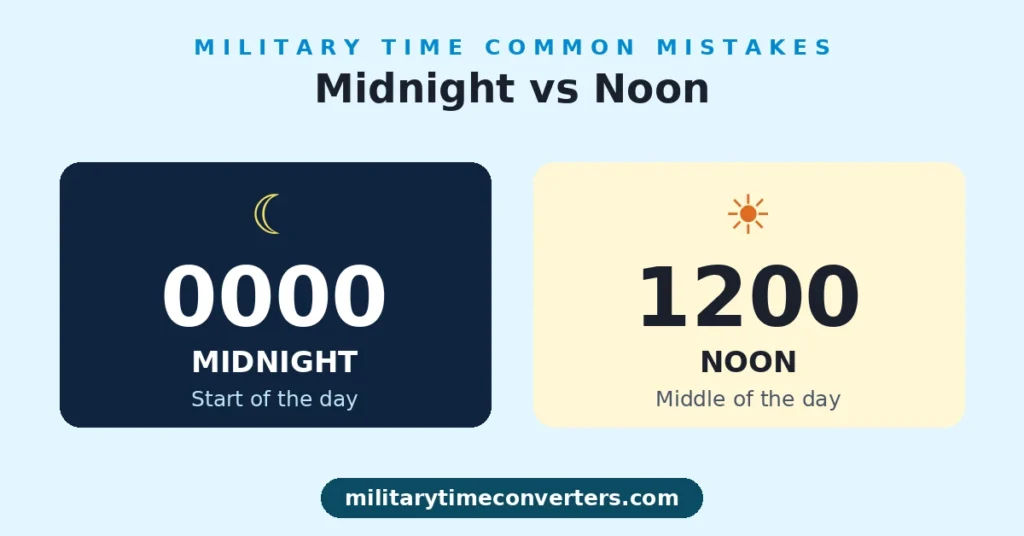
Changing the Minutes
Only the hour changes during conversion. The minutes stay exactly the same. So 1430 becomes 2:30 PM, never 2:50 or 2:35. If you catch yourself adjusting the last two digits, stop — they carry over untouched.
Getting the AM/PM Twin Wrong
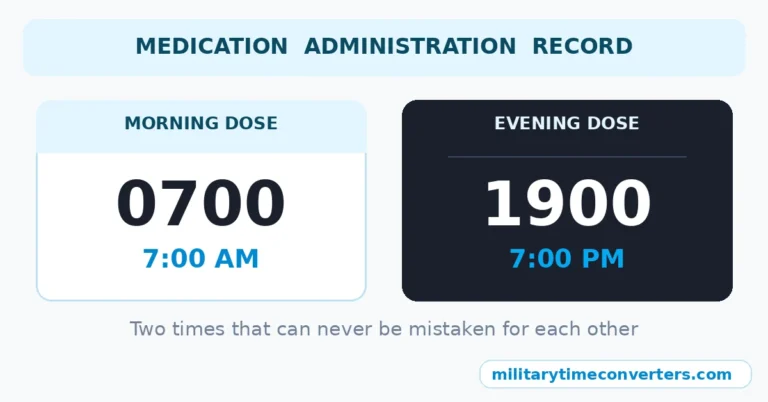
Every time from 1300 to 2359 has a morning twin twelve hours earlier, like 0700 and 1900. Mixing them up means being off by an entire half-day. In healthcare, a dose scheduled for 1900 and charted as 0700 is exactly the kind of error the 24-hour format exists to prevent. Our 0700 military time and 1900 military time pages explain how to tell this pair apart at a glance.
Mistakes When Saying Military Time Out Loud
Spoken military time has its own rules, and this is where most beginners trip up.
Saying “Thousand” Instead of “Hundred”
On the hour, military time uses “hundred,” never “thousand.” So 1000 is “ten hundred,” not “one thousand,” and 2000 is “twenty hundred.” You can hear the right pattern on our 1000 military time page.
“Oh” Versus “Zero,” and Adding “Hundred” to Minutes
Two small spoken errors show up constantly:
“Oh Six Hundred” — Movies & Everyday Talk
Saying “oh” is common in films and casual speech, but it isn’t the formal standard.
“Zero Six Hundred” — Formal Military
Formal military communication uses “zero.” And with minutes, drop “hundred”: 0530 is “zero five thirty.”
“Oh” vs “zero”: Saying “oh six hundred” is common in movies and everyday talk, but formal military communication uses “zero.” So 0600 is “zero six hundred.”
Adding “hundred” to minutes: When a time has minutes, drop “hundred.” 0530 is “zero five thirty,” not “zero five hundred thirty.”
Whether to Add “Hours”
Saying “hours” at the end, as in “fourteen hundred hours,” varies by speaker and by branch, and neither version is wrong in everyday conversation. For the full pronunciation rules, see our guide on how to read military time.
Mistakes With Time Zones and Daylight Saving
Once you add other time zones, a few more errors appear.
Forgetting the Zone Letter
A time followed by a letter, like 1430Z, isn’t a typo. The letter tells you which time zone applies. Z means Zulu time (UTC), and J (Juliett) means the observer’s own local time. Dropping or misreading that letter can put you hours off. Our military time zones guide lists every letter, and our Zulu Time Explained page shows how it’s read on real flight plans and weather reports. For the wider set of topics, see our Time Zones & Standards section.
1430Z
That Letter Is Not a Typo
The letter after a time names the zone it belongs to — Z is Zulu (UTC). Drop the letter, and the same four digits can be hours wrong.
Assuming Daylight Saving Changes the Format
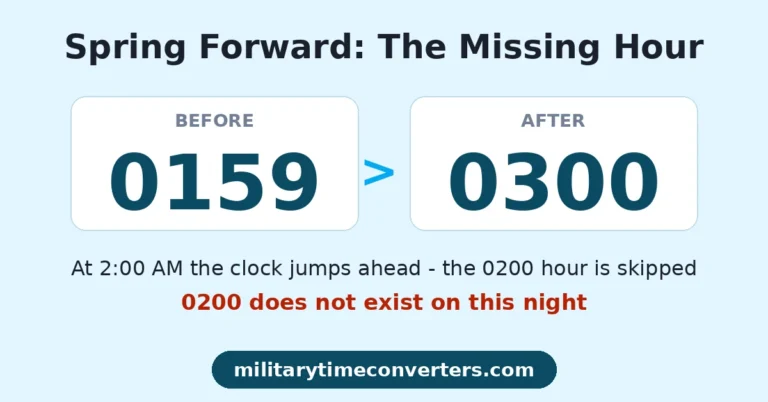
Daylight saving shifts your local clock, but it never changes the military time format. The hour just moves, as it would on any other day. We cover exactly what changes and what doesn’t in our article on whether military time uses daylight saving time.
How to Stop Making These Mistakes
Use this quick checklist whenever you write, read, or convert a time:
✓ Count four digits. If you don’t see four, add a leading zero.
✓ Check the hour. 00 to 11 is AM. 12 is noon. 13 to 23 is PM.
✓ Subtract 12 only after 1259. Never for noon, never for morning.
✓ Leave the minutes alone. Only the hour ever changes.
✓ Say “hundred” on the hour, and drop it when there are minutes.
✓ Skip the colon, AM, and PM when writing in military style.
Practice makes this automatic. Switch your phone to the 24-hour format, keep the printable chart nearby for a week, and run a few times through the converter on our homepage. For more, browse our full guide section, or jump to any hour in our military time hours library.
Conclusion
Most military time mistakes come down to a handful of habits: forgetting the leading zero, adding 12 to noon, confusing midnight with noon, altering the minutes, and saying “thousand.” Fix those five and you’ll avoid nearly every common error. When you’re unsure, use the Military Time Converters tool to check your answer, and keep the checklist above handy until the pattern feels automatic.