2400 Military Time: Why Midnight Gets a Second Notation
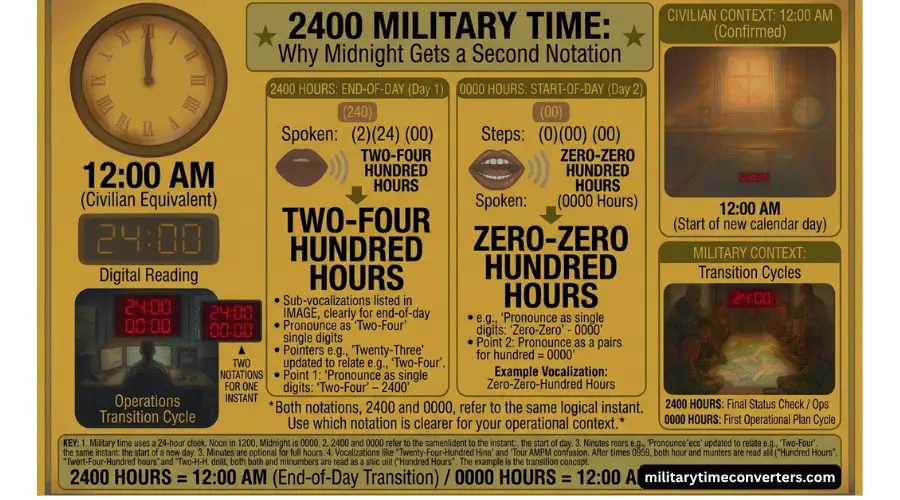
2400 military time is 12:00 AM, midnight. It’s the exact same instant as 0000, the two notations point to the identical moment, just used in different situations depending on whether that moment is closing out a day or opening a new one.
If you just needed the quick answer, that’s it. But this is genuinely one of the more interesting quirks in the whole system, so let’s get into why two different numbers exist for the same second, and where you’ll actually see 2400 used in practice. If you’d rather convert a time instantly instead, Military Time Converter has a free tool for exactly that.
Military Time → Standard Time
Type a 4-digit military time (e.g. 1830)
What is 2400 Military Time?
Unlike every other hour on the clock, 2400 military time doesn’t represent a full 60-minute stretch. There’s no “2415” or “2430” in standard usage, once a single minute passes midnight, the clock immediately becomes 0001, not 2401. 2400 exists purely as a single boundary marker, the very last possible timestamp of one day, rather than the first hour of a new one.
That’s what makes it fundamentally different from every hour page we’ve covered so far. 0000 through 2300 each describe a full hour with 60 distinct minutes inside it. 2400 describes exactly one instant and nothing more.
2400 vs 0000: Which One Should You Use?
We cover this pairing in full detail on our 0000 military time page, including the exact rule for choosing between them. Short version here: 2400 marks the end of a day that’s finishing, while 0000 marks the beginning of the day that’s starting, even though both refer to the identical moment.
How to Pronounce 2400 Military Time?
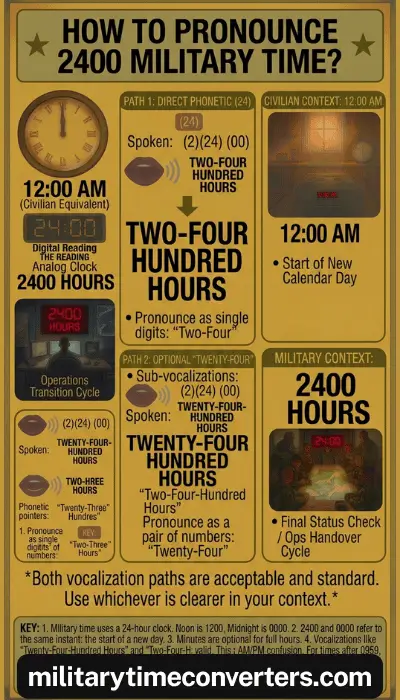
- Say it as “twenty-four hundred hours,” the standard spoken version.
- Some people simply say “midnight” instead, which is understood everywhere and carries no ambiguity.
- Paired with Zulu time, it becomes “twenty-four hundred Zulu,” referring to midnight UTC specifically.
- You won’t hear “twenty-four hundred and thirty” or anything with added minutes, since 2400 never carries minutes past zero in standard use.
“2400 in Zulu Time”
“2400Z” refers to midnight UTC, the same globally fixed reference point used throughout our military time zones guide. Because 2400 only ever marks a boundary rather than a full hour, you’ll see “2400Z” used almost exclusively to close out a date in international logs, immediately followed by “0000Z” opening the next one.
Real-World Use: Timetables, Contracts, and Legal Documents
Transportation schedules are where 2400 shows up most consistently in real life. A train or ferry timetable might list a service as departing “2400” specifically to signal it’s the very last run of the day rather than the first run of the next one, even though the clock time itself is identical to 0000.
Legal documents and contracts lean on this same distinction for a good reason. The National Institute of Standards and Technology notes that specifying an event as occurring at “0000” for the start of a day and “2400” for the end of a day removes the exact kind of ambiguity that “11:59 p.m.” or “12:01 a.m.” can create in contracts and insurance policies. When a lease, a contract, or a policy needs to specify precisely which day an event falls under, this two-notation system settles it without any room for dispute.
Real-World Use: Why Most Systems Don’t Accept 2400 as Input
If you’ve ever tried typing “2400” into a digital clock, a scheduling app, or a military time converter and had it rejected, that’s not a bug. Most systems are built to only recognize 0000 through 2359 as valid entries, treating 2400 as a display convention for specific documents rather than something you’d ever select as a start time. This is exactly why our own converter, and most others like it, will guide you toward 0000 if you’re entering a time rather than reading one off a printed schedule.
Conclusion
2400 and 0000 point to the exact same instant, midnight, but they’re used in opposite directions. 2400 closes out the day that’s ending, 0000 opens the day that’s beginning. Outside of timetables and legal documents, you’ll rarely need to write 2400 yourself, but recognizing it instantly saves you from a moment of confusion the next time you spot it on a schedule.
Head back to 2300 military time to review the hour before midnight, or start fresh with 0000 military time to see this same moment from the other direction. And if you’d rather skip the manual thinking entirely, Military Time Converter gets you there instantly.