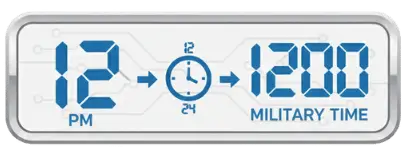
NATO Phonetic Alphabet: Complete Guide to the Military Alphabet (A–Z)
Ever tried to spell your name over the phone and the other person hears “M” when you said “N”? That mix-up is exactly what the NATO phonetic alphabet was built to fix.
Instead of saying plain letters, you say a specific word for each one. A becomes “Alpha.” B becomes “Bravo.” C becomes “Charlie.” And so on, all the way to Zulu. It sounds simple, but this small system has saved countless hours of confusion in the military, aviation, emergency response, and other industries that also rely on military time for clear communication.
In this guide, we’ll walk through the full alphabet, how to say every word correctly, where it came from, and why so many industries still rely on it today.
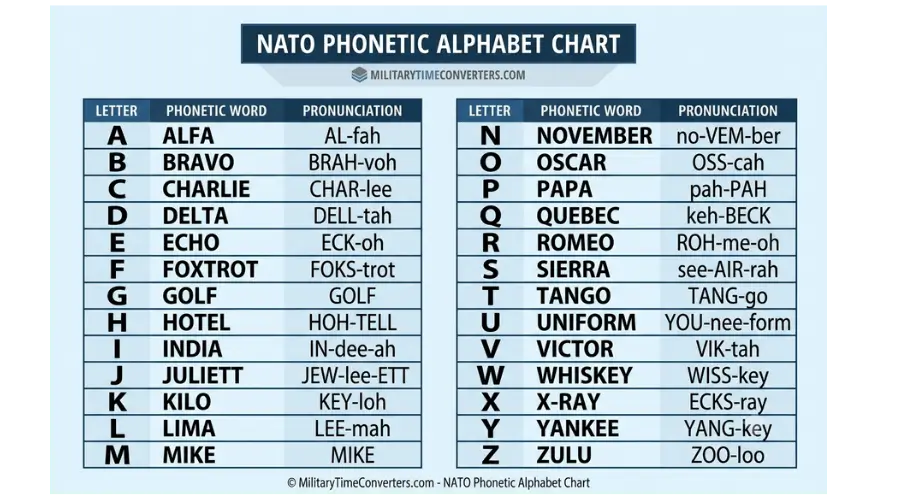
NATO Phonetic Alphabet Chart (A to Z)
Here’s the complete Military Phonetic Alphabet list. This is the standard version used internationally by militaries, pilots, and civilian organizations alike.
| Letter | Code word | Pronunciation |
|---|
What is the NATO Phonetic Alphabet?
The NATO phonetic alphabet is a set of 26 code words used to represent the letters A through Z. Instead of saying “B” (which can sound like “D” or “P” on a bad line), you say “Bravo.” Instead of “M” (which can sound like “N”), you say “Mike.”
Each code word starts with the letter it represents, which makes it easy to remember once you’ve used it a few times. The idea isn’t complicated, but the payoff is huge: it removes almost all guesswork from spoken communication, especially when accents, static, or background noise are involved.
You’ll also hear this system called the military alphabet, the radio alphabet, or the spelling alphabet. They’re all names for the same thing. If you’re new to military terminology, you may also want to learn how to read military time, another standard communication format widely used by the armed forces.
Why it’s also called the military phonetic alphabet?
The name “military alphabet” stuck because armed forces were among the first and heaviest users of this system. Soldiers needed a way to relay locations, call signs, and orders over radio without any room for misunderstanding. One misheard letter in a coordinate could send a unit to the wrong place entirely.
Even though the system is now used far beyond the military, the nickname never really went away. Today it’s still common to hear people casually refer to it as “the military alphabet,” even in completely civilian settings like customer service calls or IT support.
How to Pronounce the NATO Phonetic Alphabet?

Why “Alfa” and “Juliett” are spelled differently?
This one surprises a lot of people. “Alfa” is spelled without the “ph,” and “Juliett” has an extra “t” at the end. Neither is a typo.
These spellings exist because the alphabet needed to work across many different languages, not just English. In some languages, “ph” isn’t pronounced like an “f” sound. Spelling it “Alfa” removes that ambiguity entirely. Similarly, a single “t” at the end of “Juliet” can go silent in French pronunciation, so doubling it to “Juliett” makes sure the ending is always heard clearly, no matter who’s saying it.
NATO Phonetic Alphabet for Numbers
Letters aren’t the only thing that get mixed up over radio or phone lines. Numbers cause plenty of confusion too, especially when a connection is choppy.
To solve this, a handful of numbers get a slightly modified pronunciation.
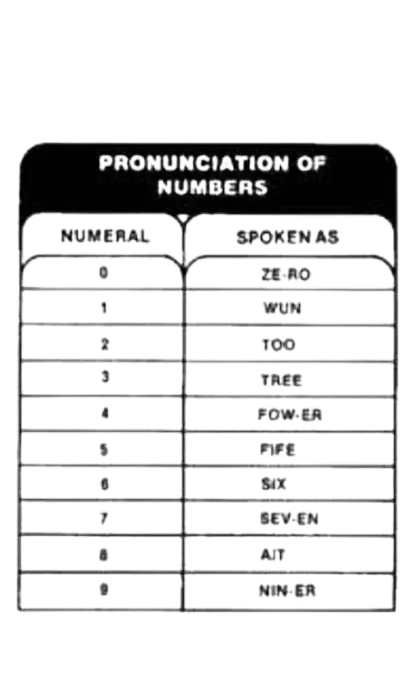
How to say 3, 4, 5, and 9 (tree, fower, fife, niner)?
“Three” is pronounced “tree” so it doesn’t get lost against other short sounds. “Four” becomes “fower,” stretched out slightly for clarity. “Five” is said as “fife,” and “nine” gets an extra “r” at the end, becoming “niner,” so it’s never mistaken for other similar-sounding words nearby.
These aren’t random changes. Each one was chosen specifically because the standard pronunciation was found to cause confusion in real radio conditions.
How to say decimal points and large numbers?
For numbers above nine, you don’t say the whole number as one word. Instead, you read out each individual digit. Ten becomes “one-zero.” A number like one hundred becomes “one-zero-zero.”
Decimal points get their own treatment too. Instead of saying “point” or “dot,” you say “decimal.” So a number like 126.59 would be read out as “one two six decimal five niner.” It sounds a little unusual at first, but it removes any chance of mishearing a decimal point over a weak signal.
“History of the NATO Phonetic Alphabet“
This system didn’t appear overnight. It took decades of trial, error, and international cooperation to land on the version we use today.
Long before NATO existed, militaries were also adopting standardized systems such as 24-hour military time to reduce communication errors. Miscommunication over radio during wartime wasn’t just inconvenient, it could be dangerous. Different countries and even different branches within the same country had their own separate spelling systems, which created chaos whenever they needed to communicate with each other.
The Able Baker alphabet (WWII origin):
During World War II, the United States combined its Army and Navy spelling systems into one shared version, known informally as the “Able Baker” alphabet, named after its first two code words. Britain’s Royal Air Force adopted a similar approach shortly after.
The problem was that this alphabet leaned heavily on English pronunciation, which made it harder for non-English-speaking allies to use effectively. As international cooperation grew after the war, it became clear a more universal system was needed.
How ICAO and NATO standardized it in 1956?
Through the 1950s, aviation and military organizations worked together to build a version that would work smoothly across English, French, and Spanish speakers alike. Several code words were adjusted specifically to be easier to pronounce and harder to confuse, no matter someone’s native language.
The final version was adopted in 1956, and it has remained essentially unchanged ever since. That kind of staying power is rare for any standard, but it speaks to how well the system was designed in the first place.
Who Uses the Military Phonetic Alphabet Today?
You might assume this alphabet stayed confined to the armed forces, but it’s spread into a surprising number of everyday industries.
Military and defense
This is where it all started, and it’s still used constantly. Service members rely on it to communicate call signs, locations, unit names, and mission updates clearly over radio. They also use military time for schedules and operations, making both systems essential for accurate communication.
Aviation and air traffic control
Pilots and air traffic controllers use this alphabet for practically every radio exchange. Flight numbers, runway identifiers, and navigation points all get spelled out phonetically to avoid any ambiguity, especially given how many different accents and languages are involved in international air travel.
Police and emergency services
Dispatchers reading out license plates, officers confirming addresses, and emergency responders relaying critical details all lean on this system daily. When every second counts, there’s no room for a mishearing to send help to the wrong place.
Common Military Phrases Using the Phonetic Alphabet
Beyond spelling individual letters, the phonetic alphabet also shows up in short, combined phrases that carry specific meanings within military communication. Here’s are few:
“Oscar Mike” is shorthand for “on the move,” used to signal that a unit is currently in transit.
“Bravo Zulu” means “well done,” a phrase that started in naval signaling and stuck around as a quick way to acknowledge good work.
You’ll also hear phrases like “Charlie Mike,” meaning “continue mission,” used to confirm an operation is proceeding as planned.
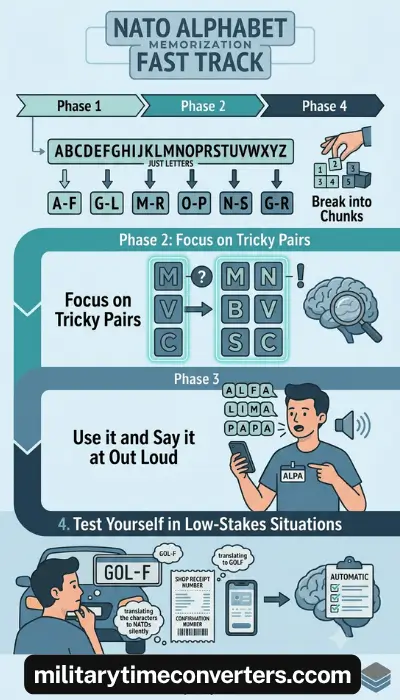
How to Memorize the NATO Phonetic Alphabet Fast?
Learning all 26 words might look intimidating at first, but it’s honestly one of the easier things to memorize once you find the right approach. Following are the simple memory tips and practice methods:
- Break it into small chunks instead of trying to learn all 26 at once. Five or six letters at a time is much easier to retain than the whole alphabet in one sitting.
- Pay extra attention to the pairs that commonly get confused, like Mike and November, or Bravo and Victor. Drilling those specifically will save you trouble later.
- The fastest way to make it stick is to actually use it, not just read it. Try spelling your own name, street address, or email out loud using the code words. Saying it out loud, rather than silently reading it, is what actually locks it into memory.
- Once the basics feel natural, test yourself in low-stakes situations, like reading a license plate on the road or a confirmation number from a receipt. By the time you actually need it in a real conversation, it’ll come out automatically.
Pros and Cons of NATO Phonetic Alphabet
Pros
Cons
Conclusion
The NATO phonetic alphabet is a simple yet powerful communication system that helps eliminate misunderstandings by assigning a unique code word to every letter of the alphabet. Whether you’re learning the military alphabet for military service, aviation, emergency response, amateur radio, or everyday phone calls, mastering these 26 code words can greatly improve communication accuracy.
By understanding the pronunciation, history, number pronunciations, and real-world applications of the NATO phonetic alphabet, you’ll be able to spell names, locations, call signs, and important information with confidence. Bookmark this guide, practice the alphabet regularly, and use our interactive chart whenever you need a quick reference.