Military Time for Nurses: A Simple Guide to 24-Hour Charting
No AM/PM confusion on charts, medication records, or shift handoffs. Learn the 3 simple rules, the common hospital times, and the one extra skill that matters most — adding hours across midnight.
📖 Guide 🏥 For Nurses & Students 🕐 24-Hour Charting
QUICK ANSWER
0700 is 7:00 AM and 1900 is 7:00 PM. In 24-hour charting, every hour of the day has its own four-digit number, so a charted time can never be read two ways. Three simple rules convert any time — and one extra skill, adding hours across midnight, covers shift and infusion math.
Nurses use military time because it removes the AM and PM confusion from charts, medication records, and shift handoffs. Every hour of the day has its own four-digit number, so 7:00 in the morning is 0700 and 7:00 in the evening is 1900. Nobody has to guess which one was meant.
If you’re a nursing student or a new nurse, you need three simple rules and one extra skill: adding hours to a start time, especially when the answer crosses midnight. This guide covers all of it in plain language. And if you want to check a time instantly while you learn, Military Time Converter converts any time in either direction.
Please note: This guide teaches the time format only. For charting and medication administration, always follow your facility’s policy and your instructor’s or supervisor’s guidance.
Why Nurses Use Military Time
Nursing is a 24-hour job, and a single wrong hour can matter. The 24-hour clock helps in two main ways. According to the open nursing textbook Nursing Skills from SaskOER, military time is the standard method used to indicate time for medication administration. It reduces the confusion that AM and PM can cause, and it avoids duplication when giving scheduled medications.
Many electronic charting systems also display times in the 24-hour format, though the exact look varies by facility. Either way, learning to read and write military time charting quickly is a core nursing skill.
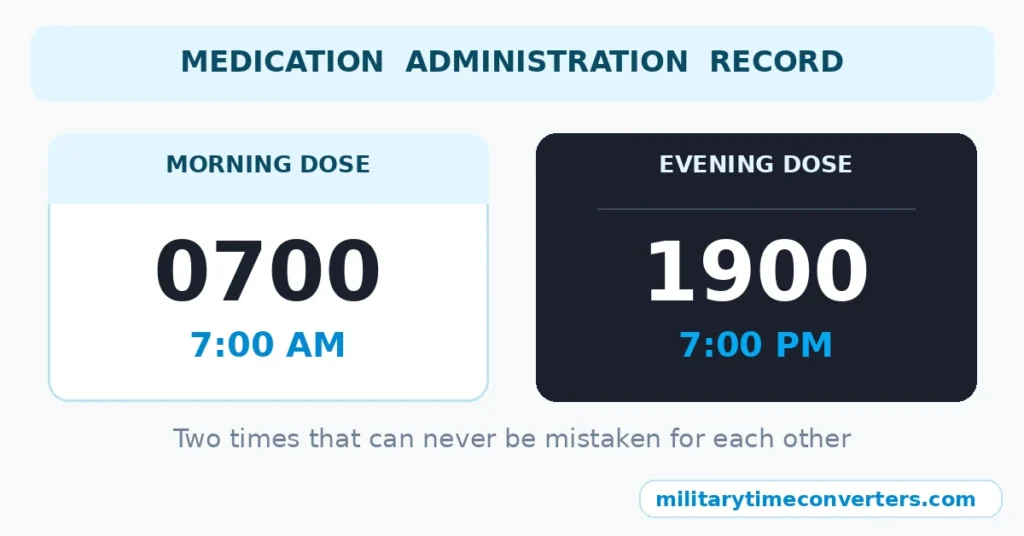
0700 vs 1900
One Medication, Two Times That Can’t Be Confused
Instead of writing that a medication is due at 7 AM and 7 PM, a medication administration record lists it as due at 0700 and 1900. Those two times can never be mistaken for each other.
The 3 Rules Every Nurse Needs
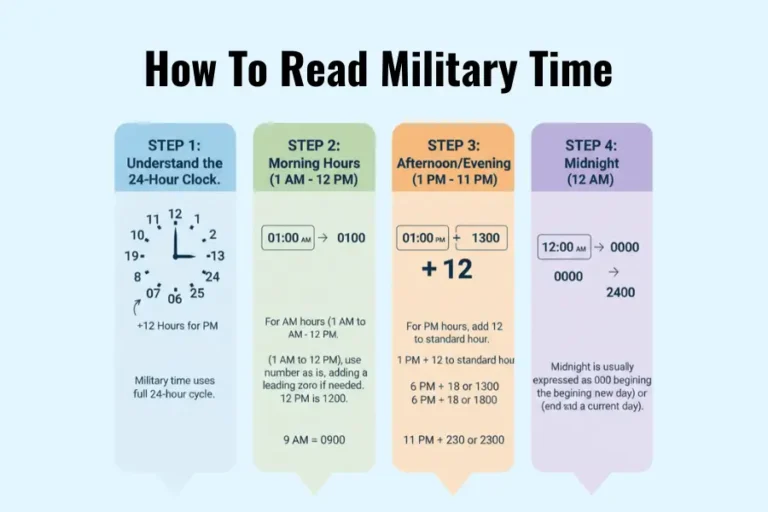
You only need three rules to convert any time:
|
If the Hour Is… |
Do This |
Example |
|---|---|---|
|
00 to 11 |
Keep the hour and add AM (00 becomes 12 AM) |
0645 → 6:45 AM |
|
12 |
Keep it and add PM (noon) |
1215 → 12:15 PM |
|
13 to 23 |
Subtract 12 and add PM |
1915 → 7:15 PM |
For the full walkthrough, see our guides on how to read military time and how to write military time. Keep our printable military time chart nearby during your first clinical weeks.
Common Hospital Times at a Glance
Every unit sets its own schedule, so treat this table as a general guide, not a rule. Each time links to its own page if you want more detail.
|
Military Time |
Regular Time |
Often Used For (Varies by Facility) |
|---|---|---|
|
6:00 AM |
Early rounds and shift changes |
|
|
7:00 AM |
Day shift start |
|
|
8:00 AM |
Morning medication pass |
|
|
7:00 PM |
Night shift start |
|
|
8:00 PM |
Evening medication pass |
|
|
9:00 PM |
Late evening medications |
|
|
12:00 AM |
Start of a new calendar date |
Common Nursing Shift Patterns
Shift lengths follow simple math. Here are the patterns you’ll see most often:
|
Shift Pattern |
Start |
End |
Length |
|---|---|---|---|
|
12-hour day |
0700 |
1900 |
12 hours |
|
12-hour night |
1900 |
0700 |
12 hours |
|
8-hour day |
0700 |
1500 |
8 hours |
|
8-hour evening |
1500 |
2300 |
8 hours |
|
8-hour night |
2300 |
0700 |
8 hours |
The Math Nurses Actually Do: Hours and Durations
Converting a single time is only half the job. Nurses also add hours to a start time and work out how long something lasts. This is where most mistakes happen, so let’s go slowly.
Adding Hours to a Start Time
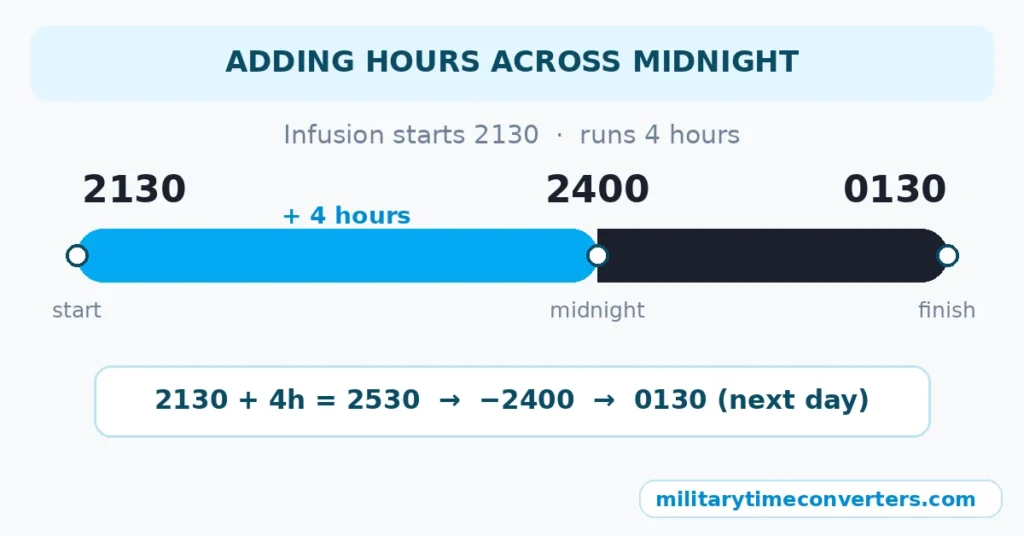
Say an infusion runs for a set number of hours and you need the finish time.
Step 1
Add the hours to the start time.
Step 2
If the answer is 2400 or higher, subtract 2400. That tells you the time on the next day.
|
Start |
Runs |
Finish |
|---|---|---|
|
1030 |
4 hours |
1430 |
|
2130 |
4 hours |
0130 (next day) |
|
2345 |
3 hours |
0245 (next day) |
|
1445 |
2 hours 30 minutes |
1715 |
The same method works for any interval. A medication given every 6 hours, for example, lands on 0000, 0600, 1200, and 1800. Intervals like this are only examples of the arithmetic. Your facility and the prescriber set the real schedule.
Working Out How Long Something Lasts
For a gap that crosses midnight, count to midnight first, then add the rest.
|
From |
To |
How |
Length |
|---|---|---|---|
|
1900 |
0700 |
5 hours to midnight, plus 7 hours |
12 hours |
|
2330 |
0615 |
30 minutes to midnight, plus 6 hours 15 minutes |
6 hours 45 minutes |
If the times don’t cross midnight, simply subtract the smaller from the larger, working minutes and hours separately.
Always follow your facility’s policy for pump settings, rate calculations, and verification. Use this math to understand the time format, not as a replacement for your protocols.
Military Time Mistakes Nurses Should Watch For
Our general guide to military time common mistakes covers every habit that causes errors. These are the ones that matter most on the unit:
Mixing Up an AM/PM Twin
0700 and 1900 are twelve hours apart, so a mix-up puts a dose or a task on the wrong half of the day.
Charting the Wrong Time
Many medication records have both a scheduled time and an actual time. Record the time as your facility’s documentation policy requires.
Confusing Midnight and Noon
Midnight is 0000 and noon is 1200. Never add 12 to noon, which would wrongly give 2400.
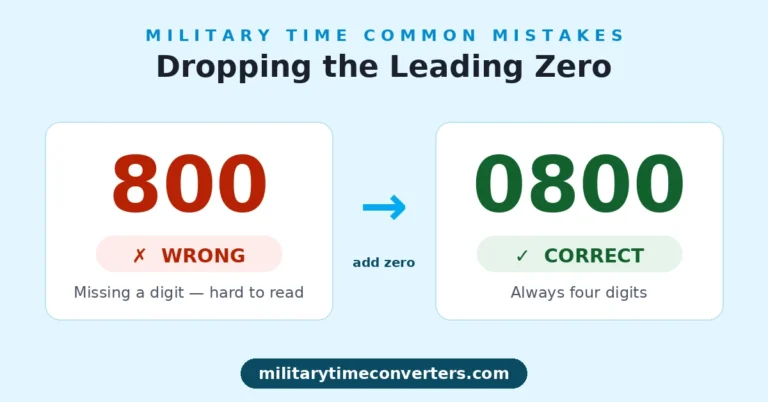
Dropping the Leading Zero
Write 0800, not 800, so the time can’t be misread.
Duration Errors Across Midnight
Forgetting to subtract 2400 is the classic slip when working out how long something lasts.

Midnight, Noon, and Daylight Saving on the Unit
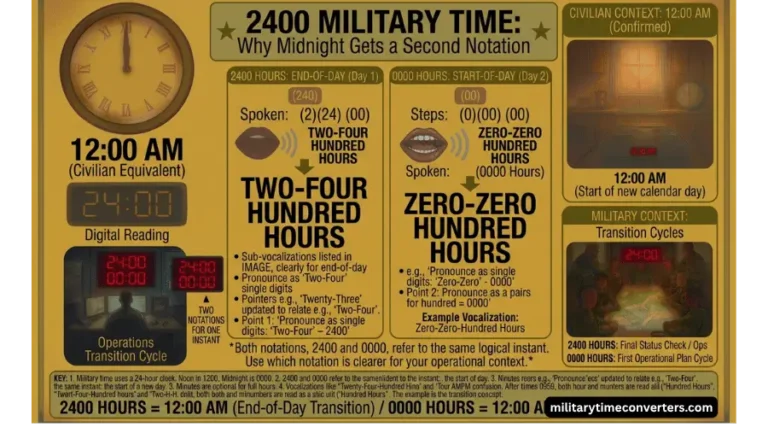
Midnight needs special care in charting. Many facilities record it as 0000, the start of a new calendar date, which means an entry a few minutes before or after midnight can land on a different date. Our pages on 0000 military time and 2400 military time explain why both notations exist and when each is used.
Daylight saving time also affects night shifts. When clocks change, an hour disappears in spring and repeats in fall. Read our article on whether military time uses daylight saving time and our 0100 military time page to see how that repeated hour works, and follow your facility’s procedure for charting during the change.
How to Practice Military Time for Nursing
Speed comes from repetition. These habits help most nursing students:
Nursing exams and clinical scenarios commonly use 24-hour times, so also practice with the exact materials your program gives you. For more beginner resources, browse our guide section or the full military time hours library.
Conclusion
Military time for nurses comes down to three rules and one skill. Know the three conversion rules, learn to add hours across midnight, and watch out for the common traps: AM/PM twins, midnight versus noon, and dropped zeros. With a little daily practice, reading and charting in 24-hour time becomes automatic.
When you need a fast check, Military Time Converter is always available.