1300 in Military Time: What Does 1:00 PM Look Like on the 24-Hour Clock?
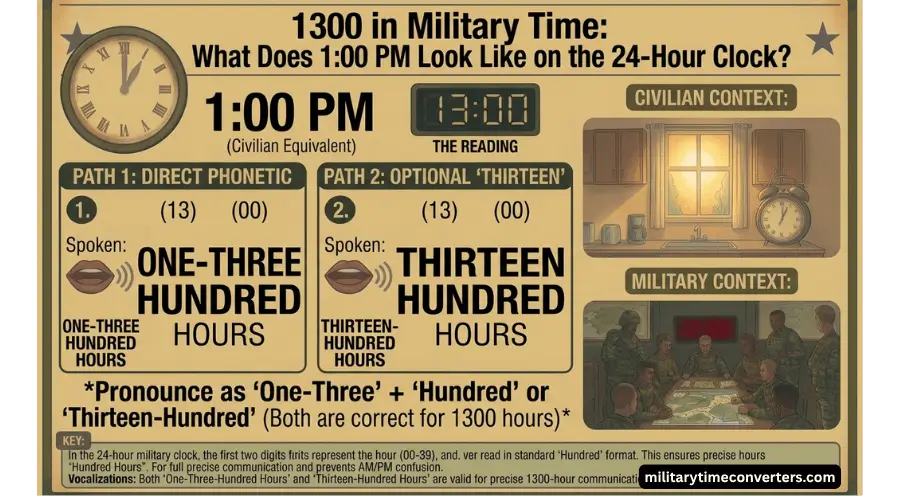
1300 military time is 1:00 PM. Fourteenth hour of the day, and this is the moment we’ve been building up to, the first hour where you actually need to do a little math to convert it.
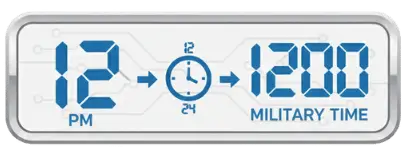
We flagged this shift coming on the 1200 military time page, and here it is. If you’ve been reading through the earlier hours, this is genuinely the biggest turning point in the entire system, so let’s slow down and walk through exactly how it works.
Military Time → Standard Time
Type a 4-digit military time (e.g. 1830)
Minute-by-Minute Chart (1300 to 1359)
Here’s every minute inside this hour, including 1330.
| Military Time | Standard Time |
|---|---|
| 1300 | 1:00 PM |
| 1305 | 1:05 PM |
| 1310 | 1:10 PM |
| 1315 | 1:15 PM |
| 1320 | 1:20 PM |
| 1325 | 1:25 PM |
| 1330 | 1:30 PM |
| 1335 | 1:35 PM |
| 1340 | 1:40 PM |
| 1345 | 1:45 PM |
| 1350 | 1:50 PM |
| 1355 | 1:55 PM |
The hour holds at 13 throughout, and the minutes climb until the clock rolls into 1400.
What is 1300 Military Time?
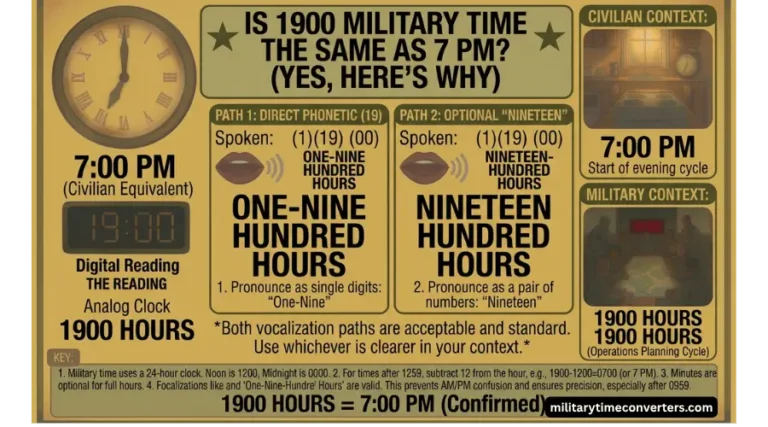
Here’s the rule, finally in action. For any hour from 1300 onward, you subtract 12 from the number, add a colon, and attach PM. So 1300 minus 12 gives you 1, which becomes 1:00, and since we’re past noon, that’s 1:00 PM.
This is genuinely the most frequently searched military time conversion out there, and it makes sense why. Up until 1200, everything converted with zero math involved. Now, starting here, every single hour through the rest of the day needs that same subtract-12 step. Once it clicks for 1300, though, it clicks for every hour after it too, since the logic never changes from here on.
What About 1330 Military Time?
1330 sits at the half-hour mark inside this hour, converting to 1:30 PM.
Subtract 12 from the hour just like before, and the minutes carry across unchanged, 30 stays 30. Same rule, same result.
Why 1300 and 0100 Get Confused?
Both times share the digit “1,” but that’s where the similarity ends. 0100 is 1:00 AM, deep in the early morning. 1300 is 1:00 PM, well into the afternoon. Twelve hours apart, yet someone skimming a schedule too quickly can easily register just the “1” and miss which half of the day it actually belongs to.
This particular mix-up tends to cause more real damage on the PM side too. Afternoon and evening times show up constantly in meetings, appointments, and daily plans, so a misread 1300 has a lot more opportunity to cause a scheduling problem than a misread 0100 does.
How to Tell 1300 and 0100 Apart at a Glance?
Here’s the accurate way to check it every time: look at the full four digits, not just the number that stands out. If the time starts with a 0, you’re looking at a very early morning hour. If it starts with a 1 and the total is 1300 or higher, you’ve moved into the afternoon.
A faster shortcut once it clicks: anything from 1300 onward has already had 12 added to it, so if the number looks “too high” to be a normal clock hour, that’s your signal you’re in the afternoon or evening. Our military time chart lays every hour out side by side, which makes this pattern easy to internalize instead of something you have to consciously check each time.
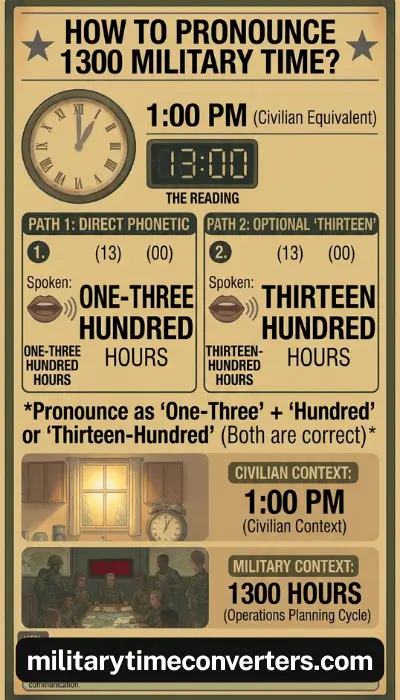
How to Pronounce 1300 Military Time?
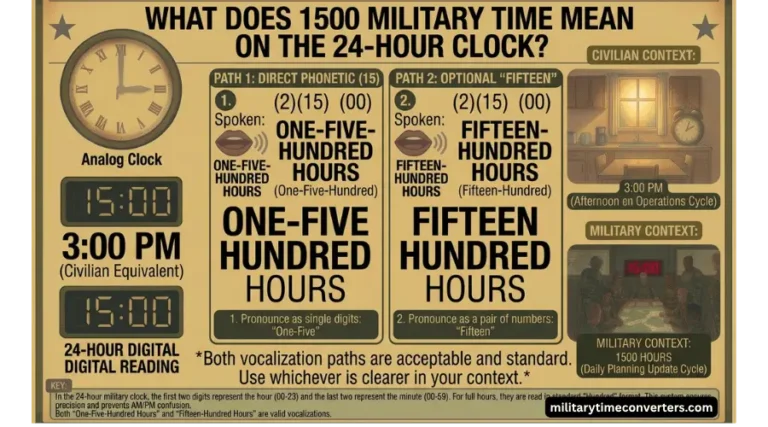
- You’ll say this one as “thirteen hundred hours.” Casually, plenty of people just say “thirteen hundred” and leave it there.
- For 1330, you’d say “thirteen thirty hours,” with the minutes read as their own two-digit number rather than folded into “hundred.”
- Paired with Zulu time, this hour becomes “thirteen hundred Zulu.”
“1300 in Zulu Time”
“1300Z” is this hour expressed in Zulu time, the military’s name for UTC. It doesn’t shift with local time zones, so 1300Z always represents the same fixed global moment no matter where you’re located.
This matters constantly in aviation coordination and international operations, where a single unmoving reference point beats juggling a dozen local times. Our military time zones guide covers the full letter-based zone system if you want to see how it all connects.
Real-World Use: Afternoon Duty Resumes
On a lot of military bases, the lunch break that opened around 1200 typically wraps up right here, with the afternoon portion of the duty day picking back up at 1300. It’s a clean, predictable handoff point, morning tasks and lunch are behind you, and whatever’s left on the schedule for the day starts fresh from this hour.
College and university course schedules lean on this same rhythm too, plenty of institutions list afternoon classes using the 24-hour format directly, so a class shown as starting at 1300 simply means 1 PM, no AM/PM label required. If you want to get comfortable writing this kind of scheduling detail yourself, our guide on how to write military time covers the formatting rules in full.
Real-World Use: The European Default
Here’s something worth knowing if you’ve ever traveled or worked internationally. In a lot of European countries, 13:00 isn’t just “military time,” it’s simply how public clocks, digital signage, and transportation schedules display the time by default, all day, every day. According to Wikipedia’s overview of the 24-hour clock, this format is the standard way of telling time in most of the world, with the 12-hour clock remaining the exception rather than the rule outside a handful of countries like the US, Canada, and a few others.
What reads as an unusual format to someone in the US is completely ordinary elsewhere, which is part of why getting comfortable with this system pays off well beyond any military or aviation context. If pronunciation across the different hours still feels inconsistent to you, our guide on how to read military time breaks the whole system down clearly, using examples just like this one.
Conclusion
Once you understand 1300 military time, the rest of the afternoon becomes much easier to read. 1300 means 1:00 PM, and 1330 means 1:30 PM. The key is that military time has moved past noon, so you subtract 12 from the hour to get the standard-time equivalent.
Ready for the next hour? Check out 1400 military time to keep the momentum going, or head back to 1200 military time if you want to review noon one more time. And if you’d rather skip the math entirely, our military time converter on the homepage handles it instantly.
Frequently Asked Questions
Summary