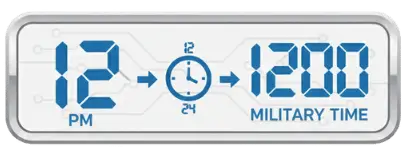
Military Time Zones: Complete A-Z Chart and Guide to Zulu Time
Have you ever heard someone say “we move at 1000 Zulu” and had absolutely no idea what that meant? You’re not alone. Once you start digging into military communication, you’ll notice time zones aren’t just called “Eastern” or “Pacific.” Instead, you’ll hear letters, Alpha, Bravo, Romeo, Zulu, and it can feel like a whole new language, similar to how the NATO phonetic alphabet works for spelling out letters.
Here’s the good news: it’s actually a simple system once someone walks you through it. In this guide, you’ll learn exactly what military time zones are, how the letters work, what Zulu time really means, and how you can convert any zone to your own local time without getting confused, alongside your regular military time conversions.
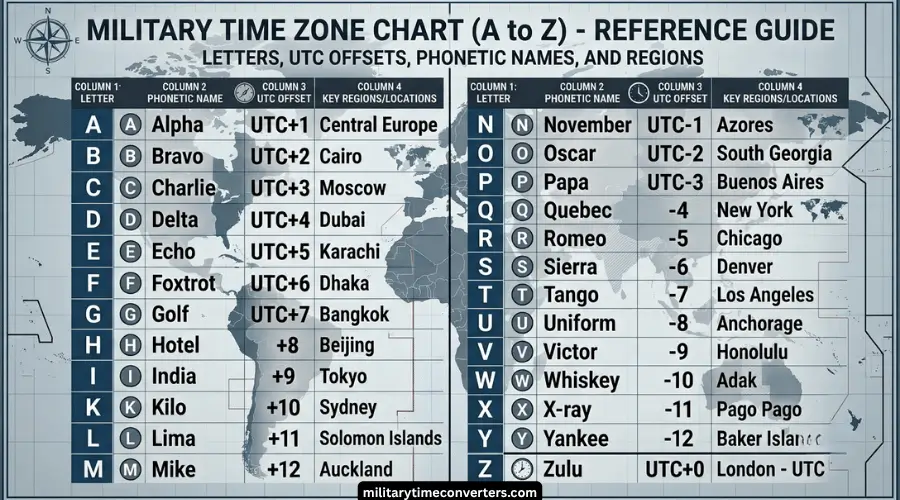
Military Time Zone Chart (A to Z)
Now let’s get into the actual chart. This is the part you’ll probably bookmark and come back to.
| Letter | Zone Name | UTC Offset |
|---|
You’ll notice the letter J is missing from this list. That’s not an accident, and we’ll explain exactly why a little further down.
What Are Military Time Zones?
Military time zones are a set of 24 time zones that cover the entire globe, and each one is assigned a single letter instead of a regional name. So instead of saying “Eastern Standard Time,” you’d say “Romeo.” Instead of “Central European Time,” you’d say “Alpha.” Every letter represents a fixed one-hour offset from a central reference point.
This system exists for one simple reason: clarity. When you’re coordinating across different countries, especially over radio where static and accents can distort words, a single letter is much harder to misunderstand than a full time zone name. If you’re new to this system, it also helps to first understand how to read military time, since the two formats are almost always used together.
Military time zone letters vs civilian time zone abbreviations:
You might be wondering why this system exists at all when civilian time zones already have abbreviations like EST or PST. The problem is those abbreviations overlap more than you’d think, “IST” could mean Indian, Irish, or Israel Standard Time depending on who you’re talking to.
Military time zones remove that ambiguity completely. Romeo is always UTC minus 5, no matter what country you’re in or what season it is.
How Military Time Zone Letters Work?
Once you understand Zulu time as the center point, the rest of the system becomes much easier to follow. Every other letter is simply an offset from Zulu, moving either east or west.
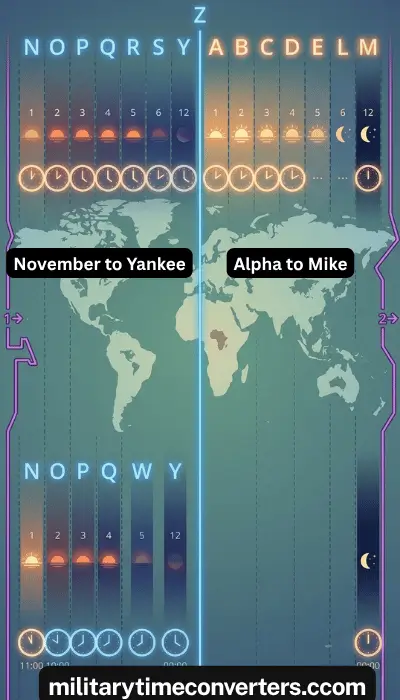
Zones east of Greenwich (Alpha to Mike)
Starting from the Prime Meridian and moving east, you’ll count upward through the alphabet: Alpha is one hour ahead of Zulu, Bravo is two hours ahead, and so on, all the way through Mike at twelve hours ahead. These zones cover regions like Europe, Africa, the Middle East, and Asia as you move further east.
Zones west of Greenwich (November to Yankee)
Moving west from Greenwich works the same way but in the opposite direction. November is one hour behind Zulu, Oscar is two hours behind, and this continues all the way to Yankee at twelve hours behind. These zones cover the Americas and stretch out toward the International Date Line in the Pacific.
Why the letter J is skipped?
This is one of the most commonly asked questions about this whole system, and for good reason, it looks like an odd gap in an otherwise clean alphabet.
The explanation actually goes back further than most people expect. This letter-based system has roots in a navigation reference published back in 1802, and even then, J was deliberately left out to avoid confusion with the letter I, since the two could look similar in certain handwriting and typeset styles of the era.
Today, J (Juliett) isn’t just skipped and forgotten though. It’s actually repurposed to represent the observer’s own local time zone, whatever that happens to be. So rather than being a wasted letter, it’s doing a very specific job: standing in for “wherever you currently are,” rather than any fixed offset.
How to Write and Pronounce Military Time Zones?
Knowing the chart is one thing, but you’ll also want to know how this actually gets written and spoken in real communication.
How to write a time with a zone letter (example: 1430Z)?
The format is straightforward once you see it. You take the standard four-digit military time and simply attach the relevant zone letter directly to the end, with no space or punctuation in between. So if something happens at 2:30 PM UTC, you’d write that as 1430Z. If the same event happened at 2:30 PM in the Romeo zone instead, you’d write it as 1430R.
This small addition does a lot of work. It tells you both the exact time and the exact zone in a single, compact notation, which is exactly what you want in fast-moving or high-stakes communication.
Pronunciation of Military Zone letters:
When you’re saying this out loud, you read the four digits first, followed by the zone letter’s phonetic name. So 1430Z would be spoken as “fourteen thirty Zulu,” and 0600R would be spoken as “zero six hundred Romeo.” You always use the full phonetic word, never just the letter itself, since a single letter said aloud is far easier to mishear than a full word like “Romeo” or “Zulu.”
“History of Military Time Zones“
This system feels modern, but its roots actually go back over two centuries. Long before NATO existed, militaries were also adopting standardized systems such as military time chart to reduce communication errors.
Origins in Bowditch’s 1802 American Practical Navigator:
The letter-based approach to time zones traces back to a navigation guide published in 1802 by Nathaniel Bowditch. At the time, sailors needed a reliable way to track time differences as they crossed the globe, long before radios or standardized global communication existed. Assigning a letter to each zone gave navigators a consistent shorthand they could rely on no matter where their voyage took them.
NATO standardized the system (ACP 121):
As military coordination became increasingly international, especially through the 20th century, a shared standard became essential. The system was eventually formalized and published as ACP 121, a communications standard used by multiple allied nations to keep radio and written communication consistent across forces.
This standardization is why the same zone letters mean the same thing whether you’re talking to a unit from the United States, the United Kingdom, or another allied nation entirely.
Who Uses Military Time Zones Today?
Even though the name suggests this is purely a military tool, it’s spread well beyond the armed forces into several other industries where precision timing really matters.
Military and defense
This is where the system started, and it’s still used constantly today. Coordinating operations across multiple countries requires a shared reference point, and zone letters give commanders and units exactly that, without any risk of confusing one region’s time zone abbreviation with another’s.
Aviation and air traffic control
Pilots and air traffic controllers rely on this system, particularly Zulu time. Flight plans, and radio communication between aircraft and ground control all use Zulu time as the standard reference, since planes are constantly crossing multiple time zones and local time simply isn’t practical for scheduling or safety.
Maritime navigation
Ships at sea face a similar challenge to aircraft, they’re often moving across several time zones during a single voyage. Using a fixed letter-based system means a ship’s crew can coordinate with ports, other vessels, and command centers without needing to recalculate local time zones constantly as they travel.
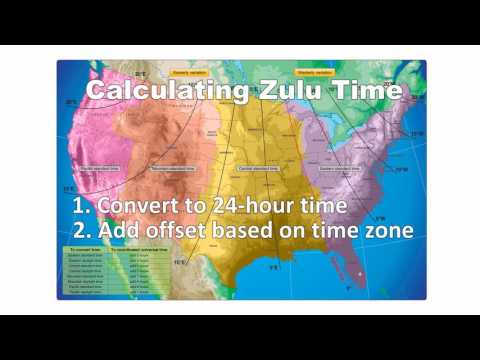
How to Convert Zulu Time to Local Time?
This is the part most people actually come looking for, so let’s walk through exactly how it works with a real example.
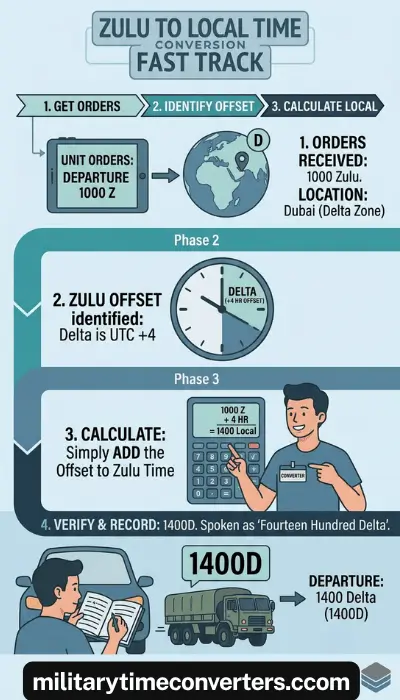
- Let’s say a unit receives orders to move at 1000 Zulu, and that unit happens to be located in Dubai, which falls within the Delta zone, four hours ahead of Zulu.
- To find the correct local time, you simply add the offset. Since Delta is UTC plus 4, you add 4 hours to 1000 Zulu, which gives you 1400 local time. Written out, that departure would be recorded as 1400D and spoken as “fourteen hundred Delta.”
- The same logic works in reverse too. If you know your local zone letter and its offset, you can always convert back to Zulu by doing the opposite calculation, subtracting instead of adding. Once you get comfortable with this back-and-forth, converting between zones becomes second nature.
Pros and Cons of the Military Time Zone System
Pros
Cons
Conclusion
Military time zones are a simple yet powerful system that removes ambiguity by assigning a single letter to every hour offset from UTC. Whether you’re in the military, working in aviation, coordinating across time zones for work, or just curious what “1000 Zulu” means, mastering this A to Z system means you’ll never be confused by a zone letter again.
Bookmark this guide, practice converting a few zones on your own, and use our chart whenever you need a quick reference.