Does Military Time Use Daylight Saving Time?
Does military time use daylight saving time? The 24-hour clock never changes — but your time zone letter can. Here is exactly what shifts during DST, what stays fixed, and why Zulu time exists.
📖 Guide🕐 24-Hour Clock🌎 Time Zones
QUICK ANSWER
Does military time use daylight saving time? No. The 24-hour format stays 0000 to 2359 all year. What shifts is your local time zone offset — and that can change which military time zone letter applies to you.
No, military time itself does not use daylight saving time. The 24-hour clock format stays exactly the same all year round, 0000 to 2359, with no changes regardless of the season. What does shift is your local time zone offset, and since that offset determines which military time zone letter applies to your location, daylight saving time can indirectly change which letter you’re using, even though the clock format itself never moves.
That distinction trips a lot of people up, so let’s break down exactly what changes, what doesn’t, and why military installations handle DST differently depending on where they’re located.
What Actually Changes During DST, and What Doesn’t
Here’s the key thing to understand: daylight saving time is a shift in your local clock, not a change to the military time format itself. When your region “springs forward” or “falls back,” your local time moves by one hour, but military time keeps counting the exact same way it always does, straight through from midnight to the next midnight.
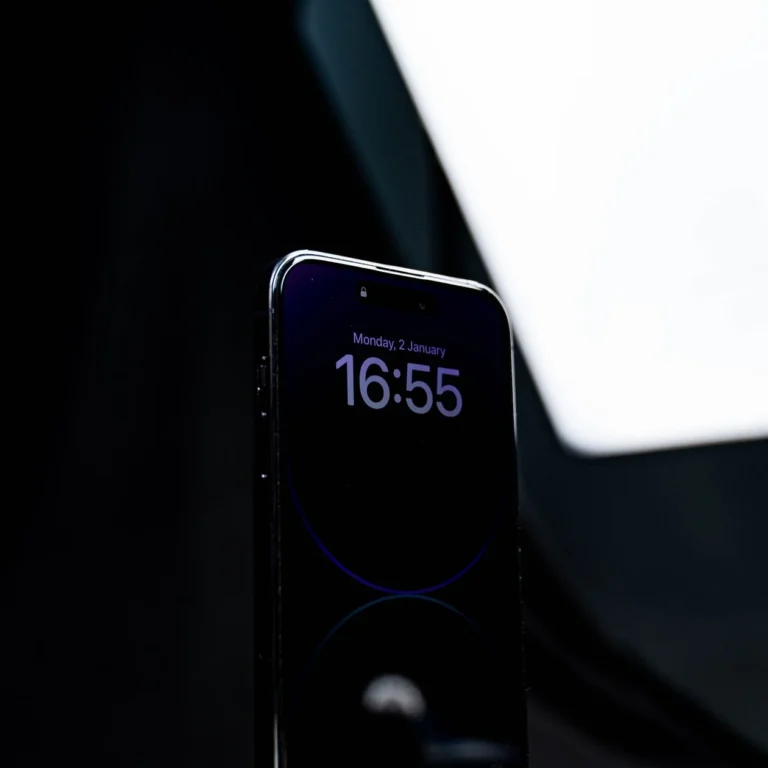
Think of it this way. If your local time moves from 1:00 AM to 2:00 AM when DST begins, that same moment in military time simply moves from 0100 to 0200, exactly as you’d expect. Nothing about the format changed, only the specific hour being displayed, the same way it would on any ordinary day when the clock advances.
What Doesn’t Change
The 24-hour format itself. It runs 0000–2359 every single day of the year, in every season, with no spring forward and no fall back built into it.
What Does Change
Your local UTC offset. When DST starts or ends, your offset moves by one hour — and that can shift which military time zone letter applies to you.
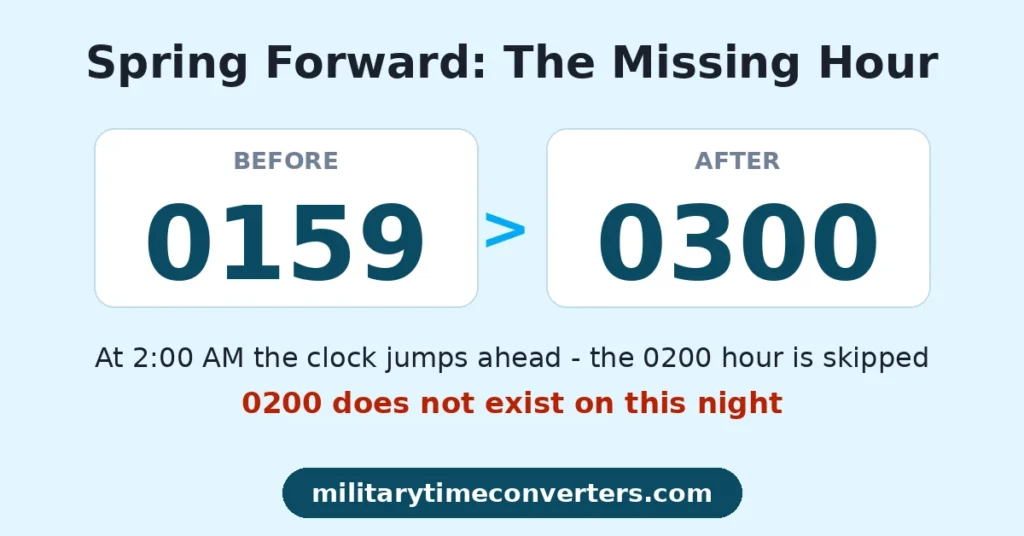
0159 → 0300
Why 0200 Is the Hour That Actually “Disappears”
In the United States, the DST transition in spring happens specifically at 2:00 AM local time, which is 0200 in military time. Clocks jump straight from 1:59 AM to 3:00 AM, meaning the entire 0200 hour technically doesn’t exist on that specific night. We cover this exact quirk, along with why 2:00 AM was chosen as the switchover point, in detail on our 0200 military time page. The reverse happens every November, when clocks “fall back” and that same hour effectively repeats. Our 0100 military time guide walks through exactly how that repeated hour gets handled in logs, schedules, and systems that record time in the 24-hour format.
Does the Military Observe Daylight Saving Time?
Yes, but only at the local level, and it depends entirely on where a given installation is located. Military bases inside the United States follow whatever daylight saving time rule applies to their state, the same as any civilian address. A base in Virginia shifts its clocks twice a year right along with the rest of the state. A base in Arizona doesn’t, because Arizona is one of the states that has opted out of observing DST entirely.
This state-by-state flexibility actually comes from federal law. Uniform Time Act of 1966 standardized daylight saving time across the US while specifically allowing individual states to exempt themselves, which is exactly why Arizona and Hawaii never change their clocks while the rest of the country does.
Which US States and Territories Skip DST
|
Location |
Observes DST? |
Military Time Zone Letter |
|---|---|---|
|
Arizona (most of the state) |
No |
Mountain (M) year-round |
|
Hawaii |
No |
Hotel (H) year-round |
|
Most other US states |
Yes |
Letter shifts with DST (see below) |
Because of this, a unit coordinating between a base in Phoenix and one in Virginia needs to account for the fact that their local offset gap actually changes twice a year, even though neither base has touched their military time format at all.
How DST Affects Military Time Zone Letters
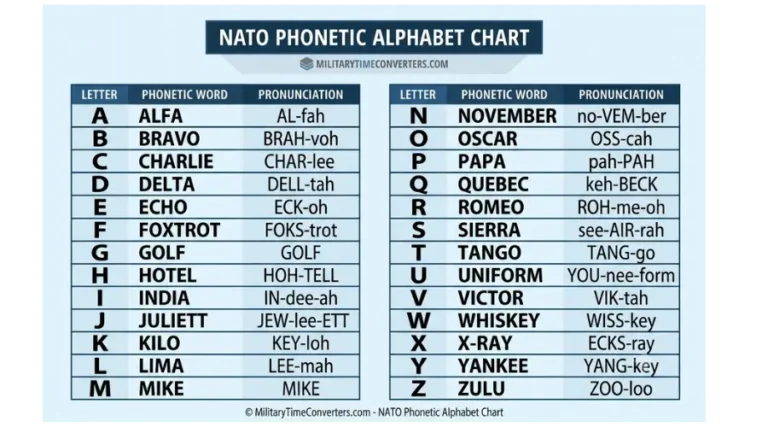
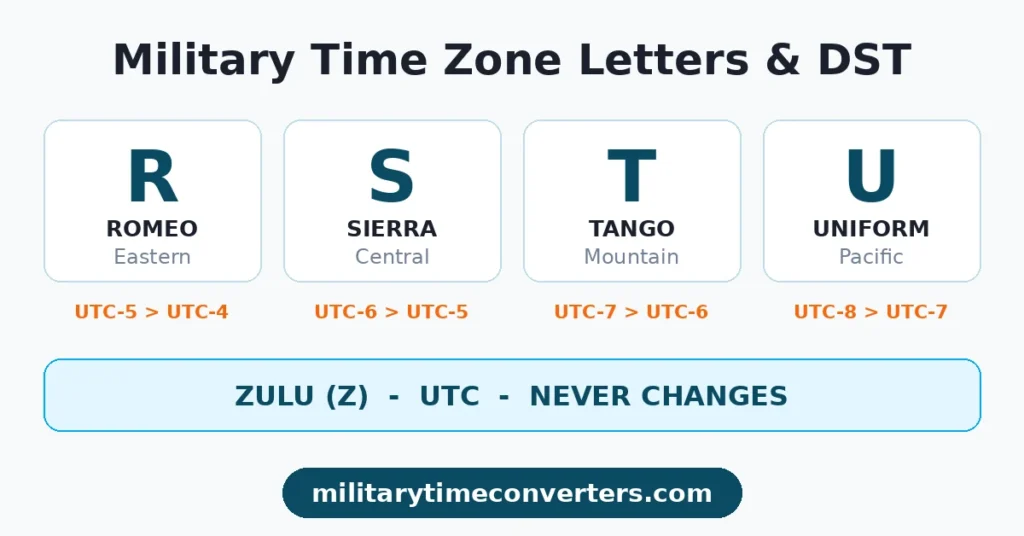
This is the part that causes the most confusion, and it’s exactly why our military time zones guide exists as a deeper resource alongside this page. Every US time zone has an assigned letter, Romeo for Eastern, Sierra for Central, Tango for Mountain, Uniform for Pacific, and each of those offsets shifts by one hour when daylight saving time is active.
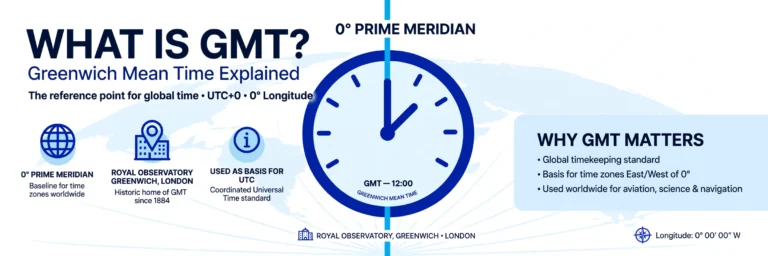
During standard time, Eastern Time sits at UTC-5 (Romeo). Once DST begins, that same region effectively operates at UTC-4, which technically corresponds to Quebec. In practice, though, most everyday military communication simply keeps using the standard letter and mentally accounts for the one-hour DST shift, rather than constantly swapping which letter gets used twice a year. This is one of the biggest reasons critical and international operations default to Zulu time instead of a local zone letter entirely, since Zulu time (UTC) never changes for daylight saving, removing this whole category of confusion in one move.
Local Letters Move
Romeo, Sierra, Tango, Uniform — every local zone’s UTC offset shifts by one hour when DST is active, so the technically correct letter can change twice a year.
Zulu Never Moves
Zulu time (UTC) is fixed year-round. That’s why critical and international operations default to Zulu instead of a local letter — it removes this whole category of confusion in one move.
If you want the full technical explanation of why Zulu stays fixed while every local offset moves around it, our What is UTC guide covers that relationship in depth.
Real-World Impact: Why This Actually Matters
For anyone working with scheduling, logs, or coordination across US time zones, this isn’t just a trivia question. A hospital shift log, a flight schedule, or a multi-base military operation that fails to account for a DST shift can end up an entire hour off, exactly the kind of mistake the 24-hour format was designed to prevent in the first place.
A few groups where this comes up constantly:
Healthcare Workers
Charting shift changes across hospitals in different states, some of which observe DST and some of which don’t
Military Units
Coordinating between bases in different time zones during the specific weekends when clocks change
Aviation Schedulers
Managing flights that cross from a DST-observing region into Arizona or Hawaii
Remote Teams
Scheduling calls across the country during the two annual transition weekends
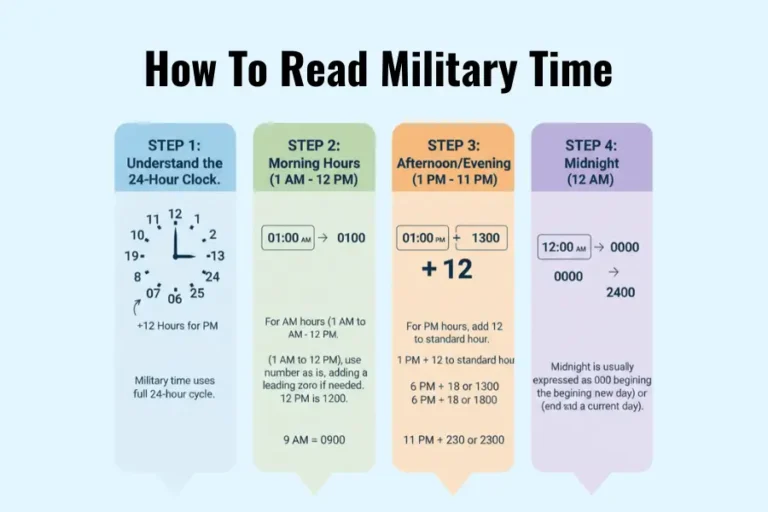
If you’re still getting comfortable with the 24-hour format itself before worrying about DST on top of it, our guides on how to read military time and how to write military time are the right place to start, and our military time converter handles any specific conversion instantly.
Conclusion
Military time itself never changes for daylight saving time. The 24-hour format stays exactly the same every day of the year. What changes is your local time zone’s offset, which in turn can shift which military time zone letter technically applies to your location, and that’s exactly why critical operations and international coordination lean on fixed Zulu time instead of a local letter that moves twice a year.
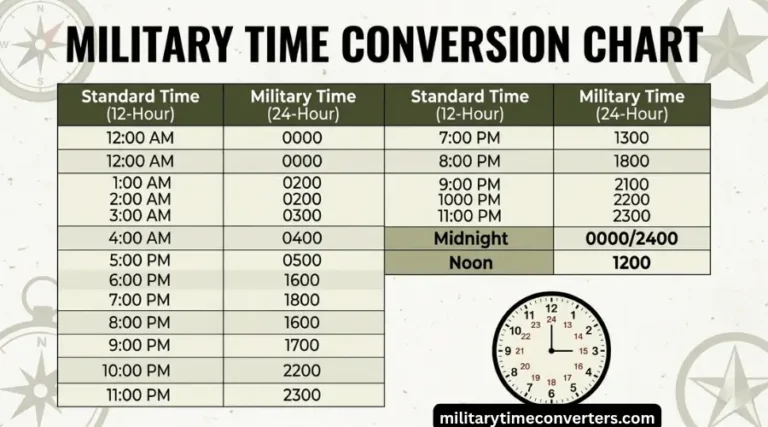
For the full A-to-Z breakdown of how every zone letter works, visit our military time zones guide, or check our military time chart for a complete hour-by-hour reference.