0100 Military Time: What is 1:00 AM in the 24-Hour Clock?
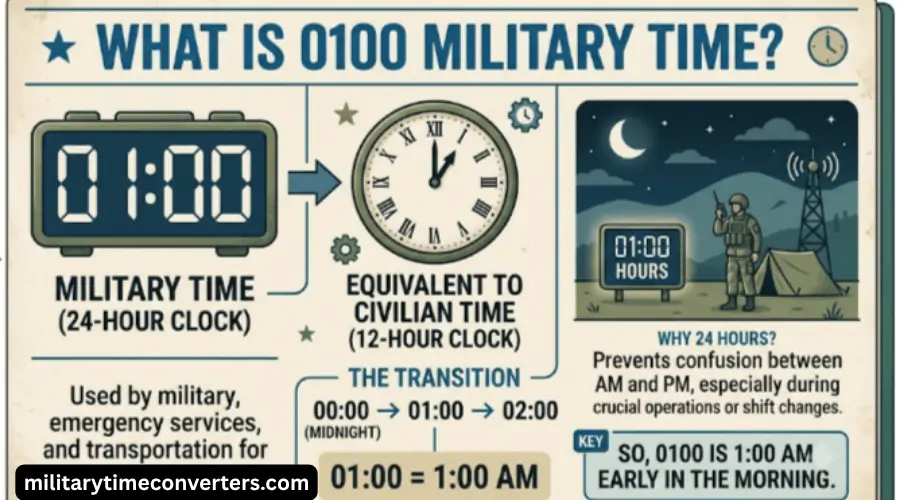
0100 military time is 1:00 AM. It’s the second hour of the day on the 24-hour clock, right after midnight, and it’s genuinely one of the easiest conversions you’ll come across.
If you just needed that answer, you’ve got it. But stick with me for a minute, because there are a couple of small details around this hour worth knowing, especially if you’ve ever mixed it up with 1300 or wondered how it’s actually said out loud. Below is our free military time converter for more conversion.
Military Time → Standard Time
Type a 4-digit military time (e.g. 1830)
Minute-by-Minute Chart (0100 to 0159)
Need a specific minute within 0100 hour? Here’s the full breakdown.
| Military Time | Standard Time |
|---|---|
| 0100 | 1:00 AM |
| 0105 | 1:05 AM |
| 0110 | 1:10 AM |
| 0115 | 1:15 AM |
| 0120 | 1:20 AM |
| 0125 | 1:25 AM |
| 0130 | 1:30 AM |
| 0135 | 1:35 AM |
| 0140 | 1:40 AM |
| 0145 | 1:45 AM |
| 0150 | 1:50 AM |
| 0155 | 1:55 AM |
Same pattern as before, the hour stays fixed at 01, and the minutes just climb normally until the clock rolls into 0200.
What is 0100 Military Time?
0100 breaks down into two parts: “01” is the hour, and “00” is the minutes. Since this falls in the early morning window, you don’t need to do any math at all to convert it.
Here’s the rule you can rely on for every hour before noon, take the number, drop the leading zero, add a colon, and tack on AM. So 0100 becomes 1:00, and since it’s a morning hour, that’s 1:00 AM. No subtracting, no adding, nothing tricky.
This is actually one of the friendliest hours to learn on if you’re just getting comfortable with military time, since anything from 0000 through 1159 works exactly the same simple way.
Why 0100 and 1300 Get Confused?
Notice the “1” in both 0100 and 1300? That’s exactly what causes people to mix them up. One lands in the dead of night, the other well into the afternoon. Our 1300 military time page walks through this pairing in full, including the fastest way to tell them apart at a glance, but the quick version is simple: check all four digits, not just the number that jumps out at you first.
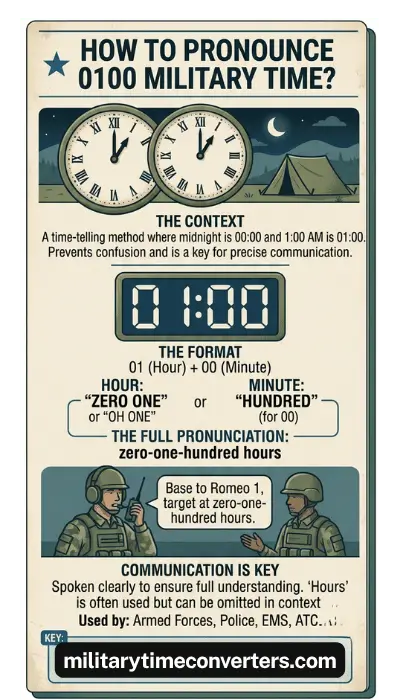
How to Pronounce 0100 Military Time?
- You’ll say this one as “zero one hundred hours.” Some people shorten it slightly to just “zero one hundred,” which is completely fine in casual conversation.
- Notice the pattern here, you always read the first two digits as their own number, “zero one,” and then add “hundred” before finishing with “hours.” That same structure carries through the entire clock, so once it clicks for 0100, you’ll find it clicks for every other hour too.
- If you’re around military or aviation radio communication, you might also hear it broken into individual digits, “zero, one, zero, zero,” just to remove any last bit of ambiguity. But in day-to-day use, “zero one hundred hours” is what you’ll hear almost every time.
“0100 in Zulu Time”
If you come across “0100Z” somewhere, that’s this same hour expressed in Zulu time, which is just the military’s name for UTC. Unlike your local time, Zulu time doesn’t shift depending on where you are, so 0100Z always points to the exact same global moment.
You’ll mostly see this in aviation schedules, military coordination, and anywhere multiple countries need one shared reference point instead of juggling several local time zones. If you want the full picture of how this letter-based system works, our military time zones guide walks through it from start to finish.
Real-World Use: Daylight Saving Time
Here’s a detail most people never connect to this specific hour. In the United States, when clocks “fall back” for daylight saving time, the change officially happens at 2:00 AM, which briefly repeats itself, meaning the hour right around 0100 to 0200 gets a little unusual once a year.
For anything logged in military time during that particular night, like hospital records, security logs, or transportation schedules, that repeated hour can create a small headache if the system isn’t set up to handle it properly. It’s a good reminder that even a “simple” hour like 0100 can get complicated in the right circumstances.
Real-World Use: Overnight Patrols and Security Shifts
This hour sits right in the middle of what’s often called the mid-watch, the overnight stretch from roughly 0000 to 0400. If you’ve ever worked or known someone who worked overnight security, this is prime territory for it, quiet hours where staying alert really matters, and where every patrol check or logged entry gets stamped in military time to avoid any AM or PM ambiguity.
It’s not just security either. Round-the-clock dispatch centers, 24-hour warehouses, and overnight retail restocking crews all tend to log activity at this hour using the same four-digit format, mostly because it removes any chance of a shift report being misread later.
Conclusion
0100 military time equals 1:00 AM on the 24-hour clock. Because it falls before noon, the conversion is simple: remove the leading zero, add a colon, and use the AM designation. Once you understand this pattern, reading every military time from 0000 to 1159 becomes much easier.
Now that 0100 makes sense, the next hour follows the exact same pattern. Take a look at 0200 military time to keep building from here, or head back to the full military time chart to see the complete picture in one place.
Frequently Asked Questions
Summary