What is UTC? How It Connects to Military Time and Zulu
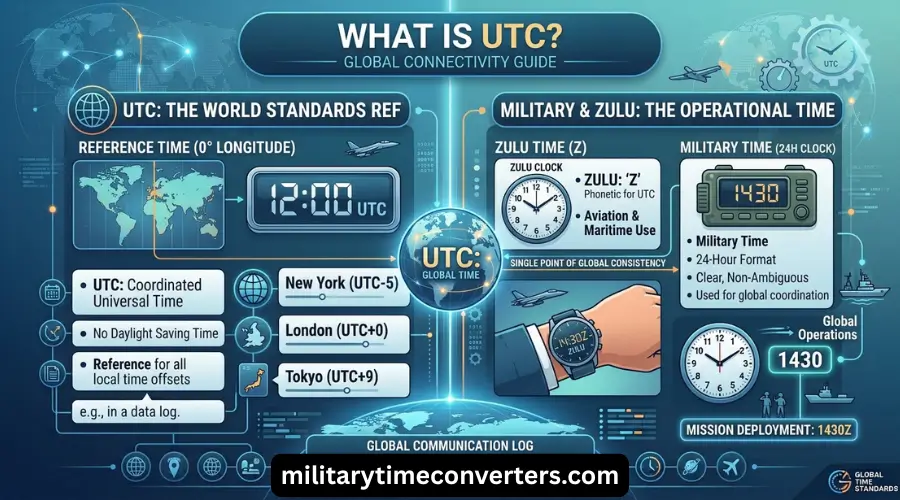
UTC stands for Coordinated Universal Time. It’s the single global time standard that every time zone in the world is measured against, and if you’ve spent any time on our military time zones guide, you’ve already run into it, it’s exactly what “Zulu time” refers to.
If you just needed that, you’ve got it. But UTC shows up constantly across military, aviation, and international coordination, so let’s walk through what it actually is, why the military renamed it “Zulu,” and how you’d convert it to your own local time. For the broader family of standards this connects to, see our Time Zones & Standards section.
Quick Facts About UTC
- What does UTC stand for? Coordinated Universal Time. The letters don’t match the English order on purpose, they’re a compromise between the English abbreviation (CUT) and the French one (TUC).
- When was UTC adopted? International coordination of time signals began in 1960, and UTC became the official global standard abbreviation in 1967.
- Does UTC have a time zone of its own? No. UTC is the zero-offset reference point (UTC+0) that every other time zone is measured against.
- Is UTC the same as military time? Not exactly. Military time is a 24-hour clock format. UTC is a specific time standard. The military uses both together, writing UTC times in the 24-hour format with a ‘Z’ attached, like 1430Z.
What is UTC?
UTC is a fixed time standard that doesn’t belong to any single country or region. Instead, every other time zone in the world is defined by how far ahead or behind it sits relative to UTC. When you see a time zone written as “UTC+5” or “UTC-8,” that number is telling you exactly how many hours that zone differs from this one shared reference point.
It’s built on an ensemble of atomic clocks maintained by national laboratories around the world, which report their measurements to a central authority that calculates the official UTC time. That’s a very different foundation than the older system it replaced, which was based on the Earth’s rotation and the position of the sun.
Why Is UTC Called “Zulu Time” in the Military?
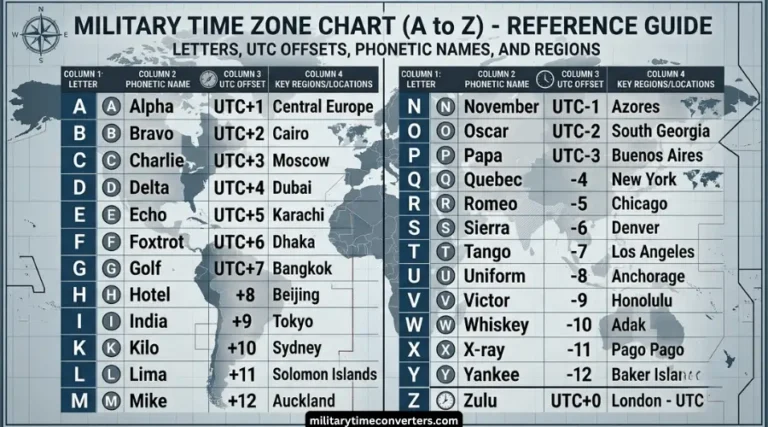
This is the part that connects directly back to everything else on this site. Zulu time is simply UTC by another name. The label comes from the NATO phonetic alphabet, where the letter Z is spoken as “Zulu,” and UTC is represented by the letter Z in the military’s zone-letter system, since it sits at zero offset, right in the center of the alphabet chart we cover in our full military time zones guide.
So when a pilot or a service member says “we move at 1430 Zulu,” they mean 1430 UTC, nothing more complicated than that. The military didn’t invent a new time standard, it just gave the existing one a name that’s impossible to mishear over a radio.
UTC vs GMT: What’s the Difference?
You’ll often see UTC and Greenwich Mean Time (GMT) used interchangeably, and for almost every practical purpose, that’s fine. GMT was the original global reference point, based on the mean solar time at the Royal Observatory in Greenwich, England. UTC eventually replaced it as the more precise, atomic-clock-based standard, and today GMT is really just one specific time zone, UTC+0, rather than the master reference it used to be.
The technical difference comes down to precision. UTC is kept in sync with International Atomic Time and adjusted with occasional leap seconds, while GMT was tied to the Earth’s slightly irregular rotation. For everyday scheduling, military coordination, or reading a flight plan, treating them as the same thing won’t cause you any problems.
Does UTC Change for Daylight Saving Time?
No, and this is one of the most useful things about it. UTC stays completely fixed all year round, it never springs forward or falls back. That’s exactly why the military and aviation industry rely on it so heavily, when you’re coordinating across a dozen time zones and some of them observe daylight saving while others don’t, a single unchanging reference point removes an entire category of scheduling errors before they happen.

How to Convert UTC (Zulu Time) to Your Local Time
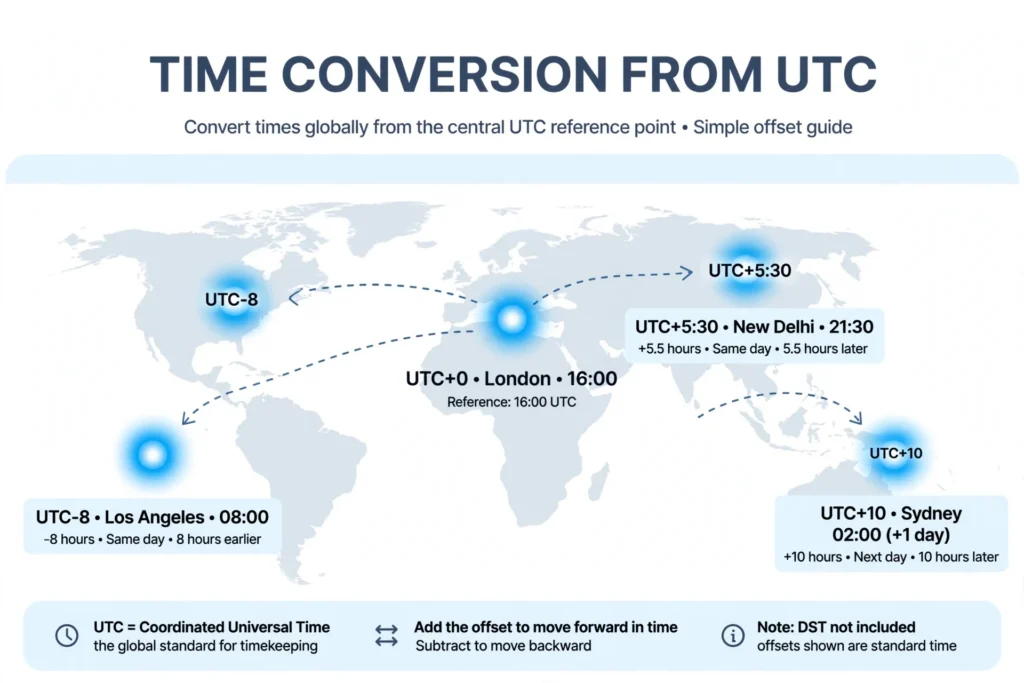
Every time zone has a fixed offset from UTC, and converting is just a matter of adding or subtracting that offset.
If your local time zone is UTC-5 (Eastern Standard Time, for example), you subtract 5 hours from UTC to get your local time. So 1500 UTC becomes 1000 local. If your zone is UTC+8, you’d add 8 hours instead, making 1500 UTC into 2300 local.
UTC Offset Chart for Common Time Zones
Here’s a quick reference for how far common time zones sit from UTC. Add or subtract the offset shown from any UTC time to get that zone’s local time.
| Time Zone | UTC Offset | 1500 UTC Becomes |
|---|---|---|
| Pacific Time (PST) | UTC-8 | 0700 |
| Mountain Time (MST) | UTC-7 | 0800 |
| Central Time (CST) | UTC-6 | 0900 |
| Eastern Time (EST) | UTC-5 | 1000 |
| Greenwich Mean Time (GMT) | UTC+0 | 1500 |
| Central European Time (CET) | UTC+1 | 1600 |
| India Standard Time (IST) | UTC+5:30 | 2030 |
| Japan Standard Time (JST) | UTC+9 | 0000 (next day) |
| Australian Eastern Time (AEST) | UTC+10 | 0100 (next day) |
The tricky part is remembering that your offset might shift with daylight saving time locally, even though UTC itself never moves. If you want to skip the mental math entirely, our military time converter on the homepage handles standard military time conversions instantly, and our zones guide has the full offset chart for every letter in the system.
How UTC Gets Written and Spoken
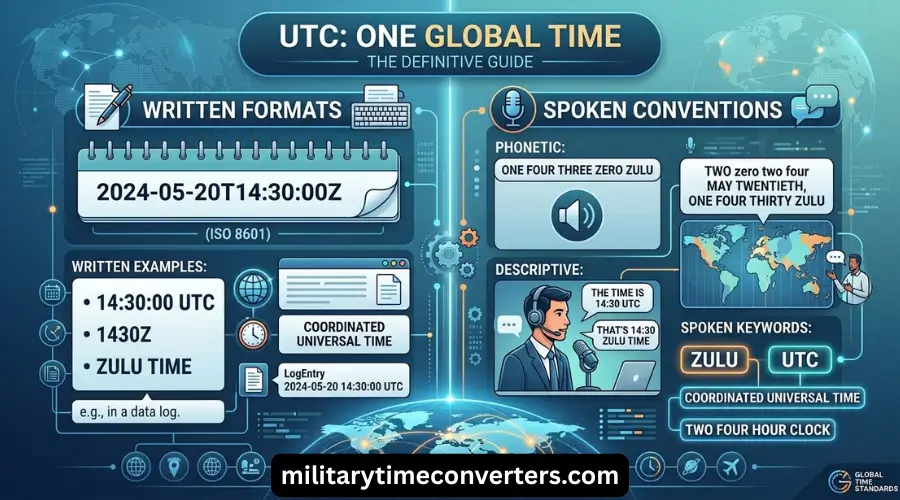
In military and aviation use, UTC times are almost always written in the same four-digit format as military time, followed by a “Z.” So 1430 UTC becomes 1430Z, spoken as “fourteen thirty Zulu.” You’ll sometimes see it with a colon instead, like 14:30Z, but the no-colon version is standard in military communication specifically because it’s faster to read at a glance.
If you want a refresher on how that four-digit pronunciation works in general, our guide on how to read military time covers the exact same logic UTC times follow. To see this exact format used in real aviation weather reports and flight plans, our Zulu Time Explained guide walks through worked examples step by step.
Real-World Use: Aviation, Military, and Maritime Operations
Pilots and air traffic controllers rely on UTC for virtually everything, flight plans, weather reports, and radio communication all default to it, since aircraft are constantly crossing time zones where local time stops being a reliable reference. According to the International Telecommunication Union, the body responsible for maintaining the UTC standard, UTC is calculated from roughly 450 atomic clocks maintained across 85 national laboratories worldwide, which gives you a sense of just how much infrastructure sits behind this one shared reference point.
Military branches lean on it just as heavily. Field reports, mission orders, and multinational coordination all get timestamped in UTC specifically so that units from different countries, often already using different local time zones, are never left guessing which day or hour an order actually refers to. Maritime operations follow the same logic, ships coordinating with ports and other vessels across the ocean need one clock everyone can agree on, regardless of where they happen to be sailing.
Frequently Asked Questions
Conclusion
UTC is the fixed, atomic-clock-based standard that every time zone in the world measures itself against, and Zulu time is simply what the military calls it. Once you understand that connection, the rest of the system falls into place, GMT is close enough to treat as the same thing in casual use, UTC never shifts for daylight saving, and converting to your local time is just a matter of applying your zone’s offset.
For the full breakdown of how every zone letter connects back to UTC, head to our military time zones guide, or use our military time converter to convert any time instantly.