What is GMT? Greenwich Mean Time Explained Simply
GMT stands for Greenwich Mean Time. It’s the original global time standard, based on the time at the Royal Observatory in Greenwich, London, and if you’ve read our What is UTC guide, you already know GMT and UTC are close enough to treat as the same thing in everyday use.
This page goes further into GMT specifically, where the name actually comes from, how it became the world’s time standard in the first place, and why it still shows up constantly even though UTC has technically replaced it.
What Does GMT Mean?
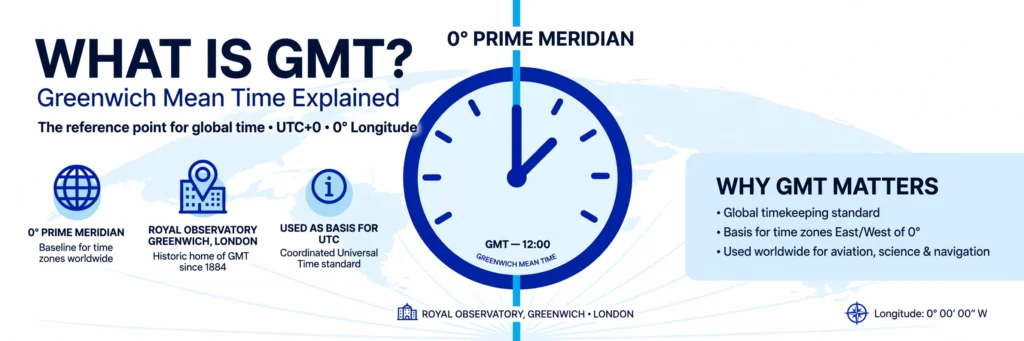
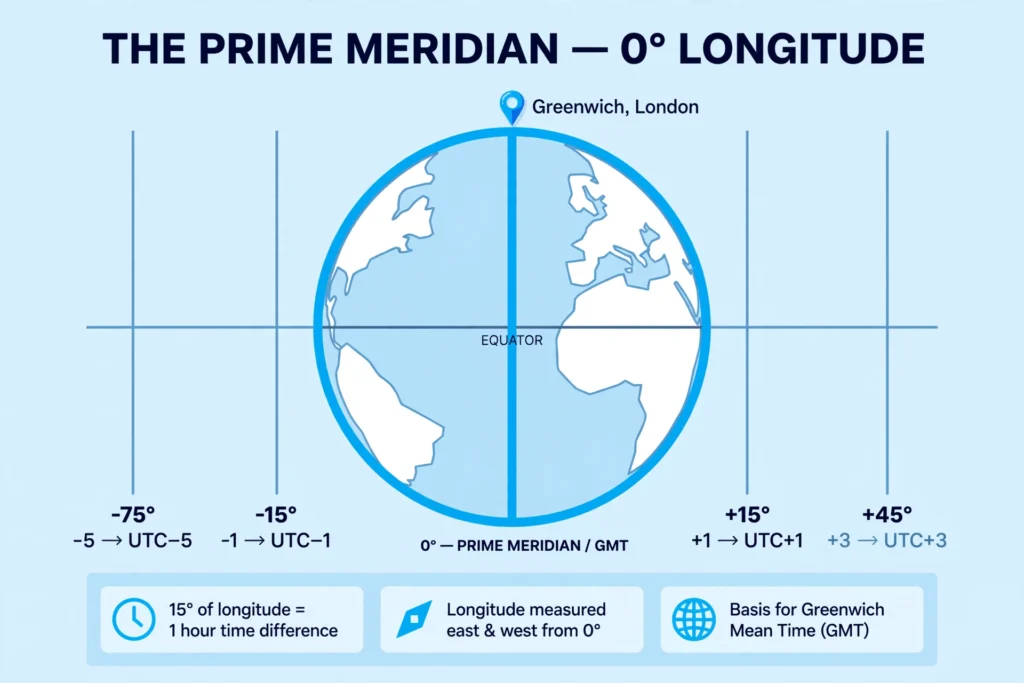
GMT is the mean solar time measured at the Prime Meridian, the 0-degree line of longitude that runs directly through Greenwich. The word “mean” refers to an average, specifically the average length of a solar day over a full year, rather than the exact position of the sun on any single day. That averaging is what makes GMT a consistent, usable clock time instead of something that drifts slightly every single day.
In practice, GMT is simply “the time in Greenwich,” and because Greenwich sits at zero degrees longitude, GMT also became the zero-point that every other time zone in the world eventually measured itself against.
Where Did GMT Come From?
The term itself dates back to 1675, tied to the founding of the Royal Observatory. The observatory’s first Astronomer Royal, John Flamsteed, developed a method for converting solar observations into a consistent clock time, work that was originally intended to help sailors determine their longitude at sea. A ship’s navigator would compare local solar noon to the time shown on a chronometer set to GMT, and the difference between the two told them exactly how far east or west of Greenwich they were.
How Railways Turned GMT Into a National Standard
For a long time, different British cities quietly kept their own local time, Bristol ran about ten minutes behind Greenwich, Cardiff about thirteen. That worked fine until railway travel made those small differences a real problem. By December 1847, British railway companies had adopted Greenwich time for their timetables, informally known as “Railway Time,” simply because a shared clock across the whole network prevented missed connections and scheduling chaos. GMT officially became Britain’s legal standard time in 1880.
How GMT Became the World’s Reference Point
GMT’s reach went global in 1884, when representatives from multiple countries agreed to adopt the Greenwich meridian as the Prime Meridian, the zero-point for longitude and time worldwide. From that point on, GMT wasn’t just Britain’s time, it was the reference every other time zone on Earth would be described in relation to, “five hours behind GMT,” “two hours ahead of GMT,” and so on.
Is GMT the Same as UTC?
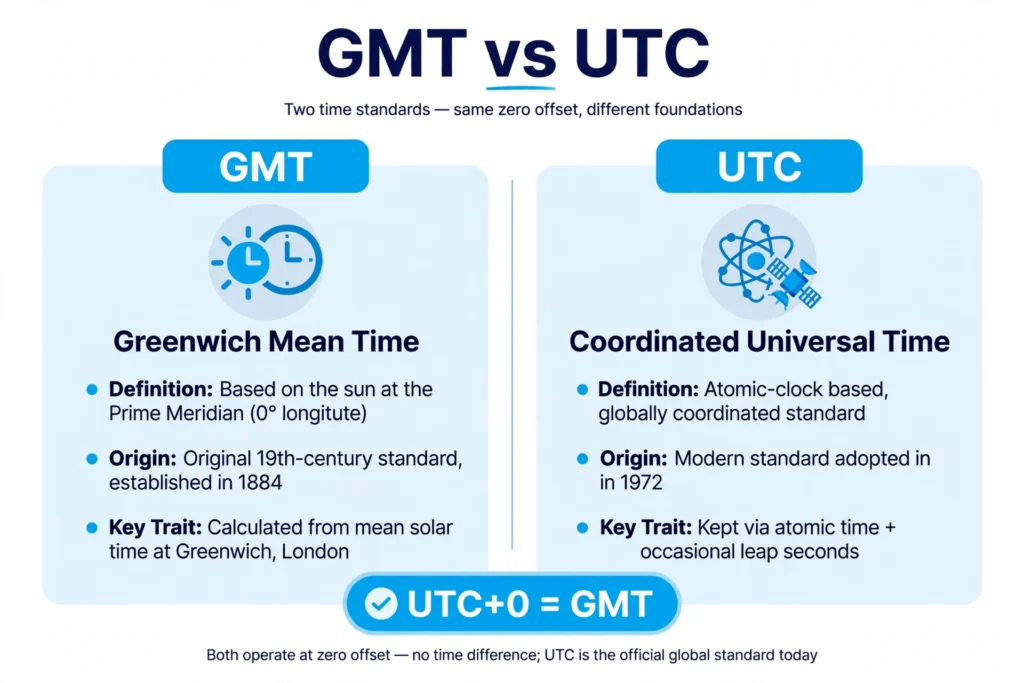
For almost every practical purpose, yes. GMT was the original global reference point. UTC, introduced in 1972, replaced it as the more precise, atomic-clock-based standard, and today GMT functions as essentially a single time zone, UTC+0, rather than the master reference it used to be.
We cover the technical difference between the two, and how UTC connects to military Zulu time, in full detail on our What is UTC page. The short version: UTC is kept in sync with atomic clocks and occasional leap seconds, while GMT was tied to the Earth’s slightly irregular rotation, a difference that matters to scientists but almost never to anyone converting a time day to day.
Is GMT Used in Military Time?
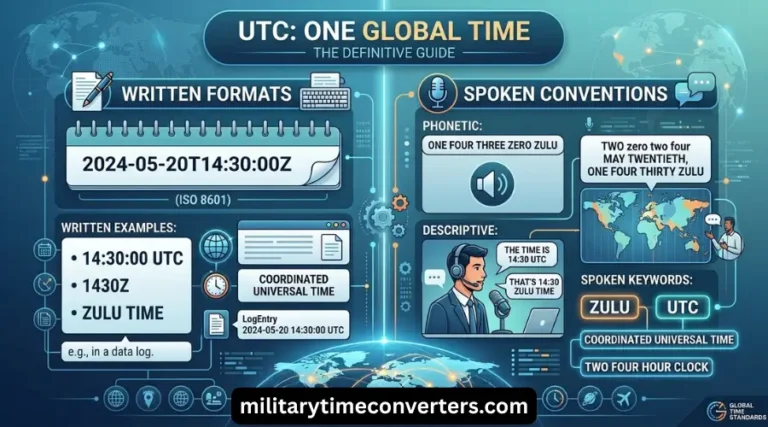
Not directly, at least not under its own name. Military and aviation communication standardized on UTC, spoken as “Zulu,” rather than GMT specifically, mainly because UTC’s atomic-clock precision made it the more reliable choice once it became available. That said, since GMT and UTC share the same offset (UTC+0), any time written as “1430 GMT” and “1430Z” refer to the exact same moment in practice.
GMT still holds on in a few specific contexts worth knowing. According to aviation industry sources, GMT remains relevant in legal and broadcasting contexts in the UK, and the term is still used informally during the UK’s winter months when the country isn’t observing daylight saving time. Our Zulu Time Explained guide covers how UTC itself gets used in real aviation and military scenarios, including how it’s written and spoken on flight plans and weather reports.
Quick Facts About GMT
- GMT is based on the position of the sun at the Prime Meridian in Greenwich, London.
- The term dates back to 1675, tied to the founding of the Royal Observatory.
- British railways adopted GMT nationally in 1847 to standardize train timetables.
- GMT became Britain’s legal standard time in 1880, and the world’s reference point in 1884.
- UTC replaced GMT as the technical global standard in 1972, though the two remain interchangeable in casual use.
Which Countries Still Use GMT?
A handful of countries in Western Europe and Africa keep their clocks on GMT year-round or for part of the year, including the United Kingdom during its winter months (before British Summer Time begins), along with countries like Iceland, which stays on GMT all year without ever shifting for daylight saving. Anywhere you see a time zone labeled “GMT+1” or “GMT-5,” that offset is being measured against this same Greenwich reference point, the identical concept behind the UTC offsets covered in our military time zones guide.
Real-World Use: Navigation, Broadcasting, and Everyday Reference
GMT’s original purpose was solving a navigation problem, helping sailors calculate longitude by comparing local solar time to a fixed reference clock. That maritime role has since been replaced by GPS and UTC-based systems, but GMT’s influence never really went away. UK broadcasters, legal documents, and public clocks still reference GMT by name, and because GMT and UTC share the same zero offset, learning to read one means you already understand the other.
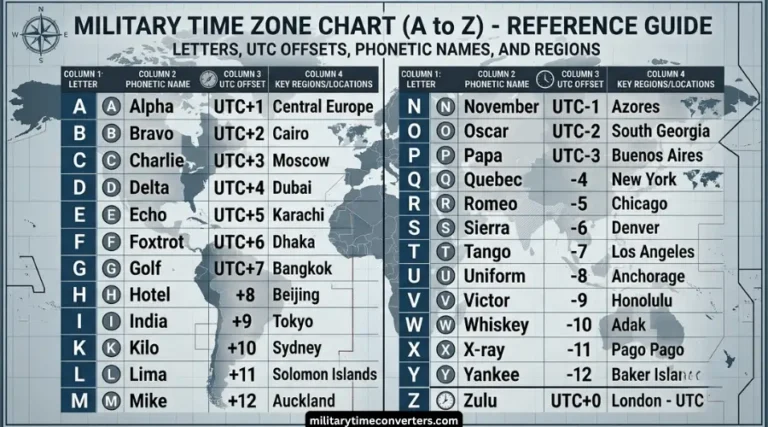
For anyone working with military time, this matters mainly as background context. The zone letter “Z” in our military time zones guide represents the same zero-offset point GMT originally defined, UTC simply took over the technical role GMT used to play.
Conclusion
GMT is Greenwich Mean Time, the original global reference point, born from a 17th-century navigation problem and later standardized through Britain’s railways before becoming the world’s time standard in 1884. UTC has since taken over as the technical, atomic-clock-based version of the same idea, but GMT’s zero-offset position, and its name, are still very much in everyday use.
For the modern, military and aviation version of this same standard, see our What is UTC guide, or convert a specific time instantly with our military time converter.