What Does 1700 Military Time Mean? (It’s 5:00 PM)
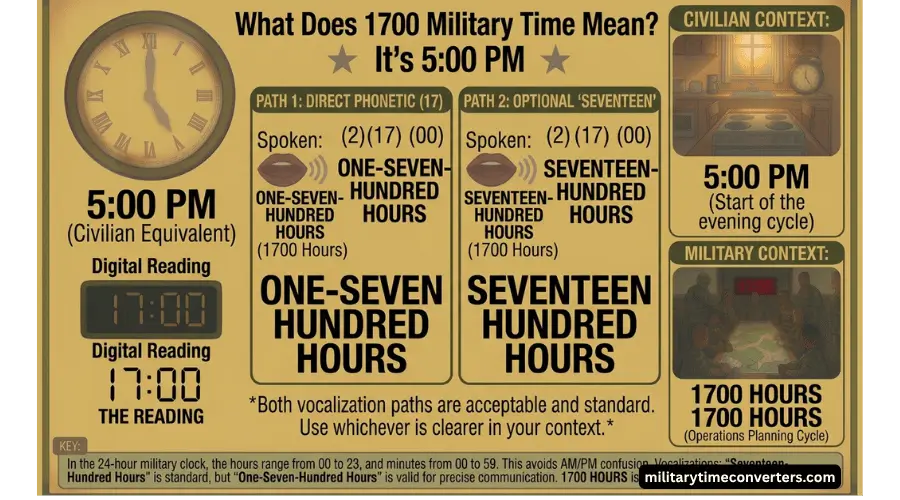
1700 military time is 5:00 PM. Eighteenth hour of the day, and it happens to be one of the most searched conversions on the entire clock, probably because so many workdays and shifts end at exactly this hour. If you’d rather skip the explanation and just get an instant answer, Military Time Converter has a free tool built for exactly that.
Let’s run through the conversion, cover pronunciation, and get into where this hour shows up constantly, both in and out of uniform.
Military Time → Standard Time
Type a 4-digit military time (e.g. 1830)
Minute-by-Minute Chart (1700 to 1759)
Here’s every minute inside this hour, including 1730.
| Military Time | Standard Time |
|---|---|
| 1700 | 5:00 PM |
| 1705 | 5:05 PM |
| 1710 | 5:10 PM |
| 1715 | 5:15 PM |
| 1720 | 5:20 PM |
| 1725 | 5:25 PM |
| 1730 | 5:30 PM |
| 1735 | 5:35 PM |
| 1740 | 5:40 PM |
| 1745 | 5:45 PM |
| 1750 | 5:50 PM |
| 1755 | 5:55 PM |
The hour holds at 17 throughout, minutes climbing until the clock rolls into 1800.
What is 1700 Military Time?
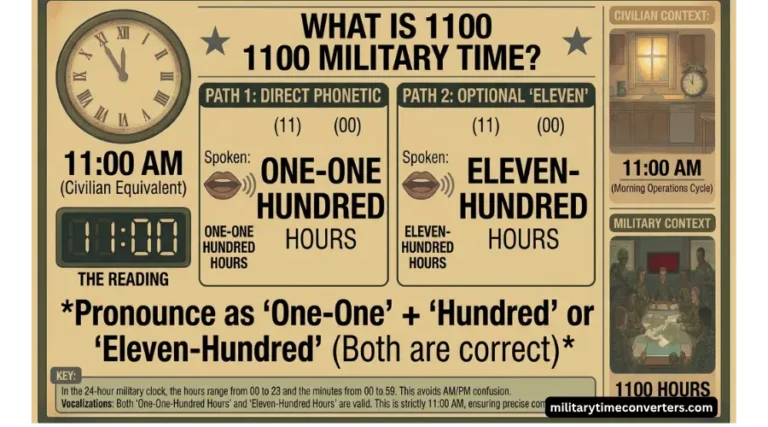
Take 17, subtract 12, and you get 5. Add the colon, attach PM, done, 5:00 PM. Same subtract-12 process you’ve been using since 1300, and it holds steady for the rest of the day from here.
What About 1730 Military Time?
1730 follows the same math, subtract 12 from the hour to get 5, keep the minutes at 30. That gives you 5:30 PM, no extra steps involved.
Why 1700 and 0500 Get Confused?
Both hours are technically “five o’clock,” and that shared number is exactly the trap. 0500 sits in the early morning, while 1700 lands right at the close of a standard workday, twelve hours apart despite looking nearly identical at a glance.
This particular pairing carries real weight, since 1700 is one of the most frequently referenced hours in daily life, appointment reminders, closing times, and end-of-shift notifications all cluster around it, giving a misread far more opportunity to cause an actual scheduling problem than most other hour pairs would.
How to Tell 1700 and 0500 Apart at a Glance?
Quick check: anything 1300 or higher has already had 12 added to it, so 1700 is an immediate signal you’re looking at the evening, not the early morning.
0500 always carries that leading zero, your clearest sign you’re looking at a pre-dawn hour instead. Our 0500 military time page covers this same pairing from the other side if you want the complete picture.
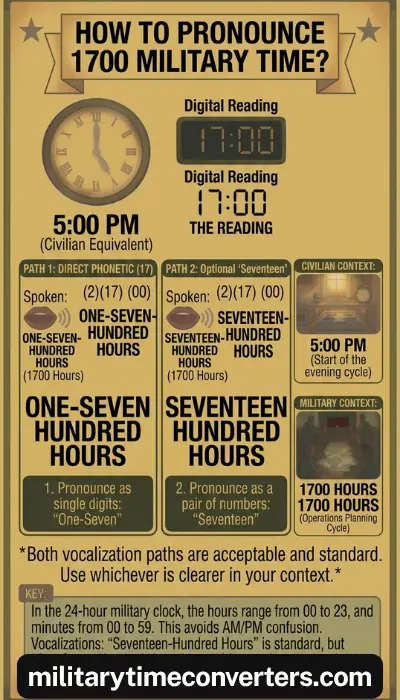
How to Pronounce 1700 Military Time?
- Say it as “seventeen hundred hours,” or just “seventeen hundred” once you’re comfortable dropping the formal ending. For 1730, that becomes “seventeen thirty hours,” with the minutes read as their own two-digit number. Paired with Zulu time, this hour is “seventeen hundred Zulu,” a level of precision that traces back to the same logic behind the NATO phonetic alphabet, where every sound is chosen specifically to survive a bad connection.
“1700 in Zulu Time”
“1700Z” is this hour in Zulu time, the military’s version of UTC, fixed regardless of your local time zone. International airlines lean on this heavily, a flight departure listed as 1700Z means the same fixed moment worldwide, even though the local clock time at the gate will look completely different depending on where that gate actually is.
Our military time zones guide breaks down the full letter-based system if you want to see how Zulu connects to every other zone on the clock.
Real-World Use: The “Nine to Five” Connection
If you’ve ever used the phrase “nine to five” to describe a standard workday, you’ve been speaking in military time without realizing it. That familiar civilian phrase translates directly to 0900 to 1700, and Merriam-Webster traces the idiom back to describing a typical workday schedule, which is part of why this exact hour feels so instantly recognizable even to people who’ve never worn a uniform. Government offices and plenty of civilian businesses still build their entire posted hours around this exact bookend.
For a deeper look at how the morning side of that phrase works, our 0900 military time page walks through the leading-zero milestone tied to that hour specifically.
Real-World Use: Evening Shift Change and Closing Time
Hospitals commonly run evening shift changes at either 1500 or 1700 depending on the facility, making this hour one of the more common handoff points in healthcare scheduling, right alongside patient chart closings and medication log updates. Retail stores and government service counters lean on it too, plenty of businesses list 1700 as their official closing time, especially ones that opened at 0900 to match that same “nine to five” rhythm.
Want to see every hour we’ve covered laid out together? Our full military time chart page organizes the entire 24-hour system in one place, with every conversion just a click away.
Conclusion
At this point, the conversion pattern should be second nature: 1700 military time is 5:00 PM, and 1730 is 5:30 PM. The key is remembering that times from 1300 onward belong to the PM portion of the day, so you subtract 12 from the hour while leaving the minutes unchanged.
Keep going with 1800 military time, or head back to 1600 military time to review the hour before this one. And if you’d rather skip the math entirely, Military Time Converter gets you the answer instantly.
Frequently Asked Questions
Summary