1500 Military Time: What Time Is It Really?
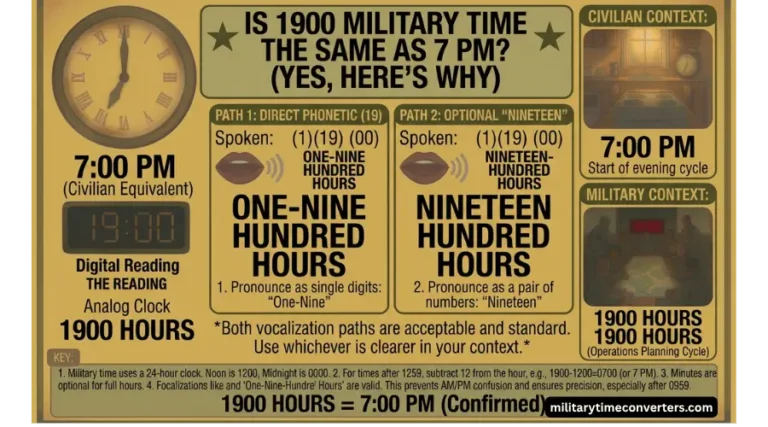
1500 military time is 3:00 PM. Sixteenth hour of the day, right in the mid-afternoon stretch, and the subtract-12 rule you picked up back at 1300 applies here exactly the same way.
Let’s run through the conversion, cover pronunciation, and get into a few places this hour shows up that might genuinely surprise you.
Military Time → Standard Time
Type a 4-digit military time (e.g. 1830)
Minute-by-Minute Chart (1500 to 1559)
Here’s every minute inside this hour, including 1530.
| Military Time | Standard Time |
|---|---|
| 1500 | 3:00 PM |
| 1505 | 3:05 PM |
| 1510 | 3:10 PM |
| 1515 | 3:15 PM |
| 1520 | 3:20 PM |
| 1525 | 3:25 PM |
| 1530 | 3:30 PM |
| 1535 | 3:35 PM |
| 1540 | 3:40 PM |
| 1545 | 3:45 PM |
| 1550 | 3:50 PM |
| 1555 | 3:55 PM |
The hour holds at 15 throughout, minutes climbing until the clock rolls into 1600.
What is 1500 Military Time?
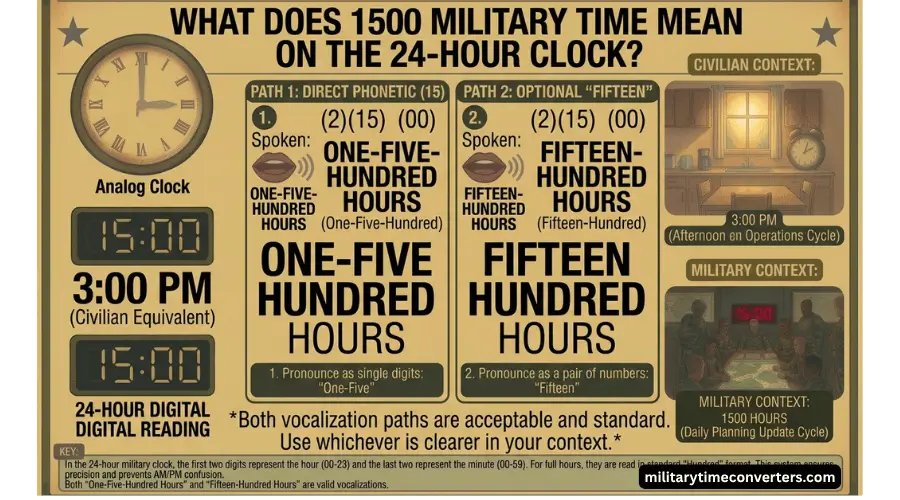
Take 15, subtract 12, and you get 3. Add the colon, attach PM, done, 3:00 PM. Same process as every hour since 1300, and it stays this simple for the rest of the day now.
What About 1530 Military Time?
1530 follows the same math, subtract 12 from the hour to get 3, keep the minutes at 30. That gives you 3:30 PM, no extra steps involved.
Why 1500 and 0300 Get Confused?
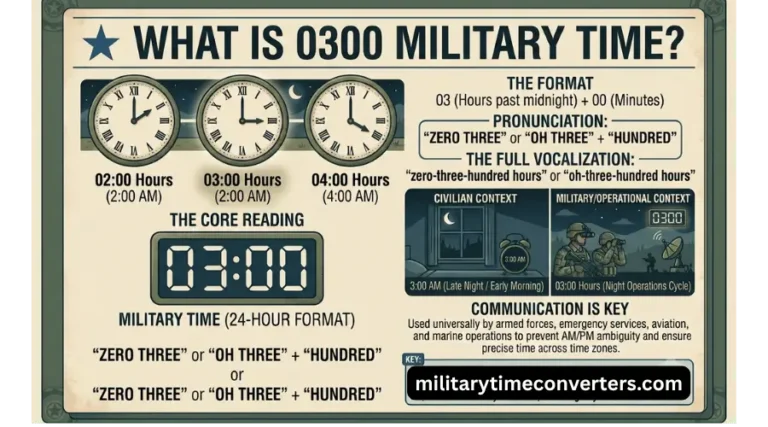
Both hours are technically “three o’clock,” and that shared number is exactly the problem. 0300 sits deep in the early morning, while 1500 lands squarely in the middle of the afternoon, twelve hours apart despite looking similar at a glance.
This mix-up tends to matter more on the 1500 side specifically, since mid-afternoon is when a huge share of daily meetings, appointments, and shift changes actually happen. A misread 1500 has a lot more chances to cause a real scheduling headache than a misread 0300 typically does.
How to Tell 1500 and 0300 Apart at a Glance?
Quick check: anything 1300 or higher has already had 12 added to it, so 1500 is an immediate signal you’re in the afternoon.
0300 always carries that leading zero, your clearest sign you’re looking at an early morning hour instead. Our 0300 military time page covers this same pairing from the other side if you want the complete picture.
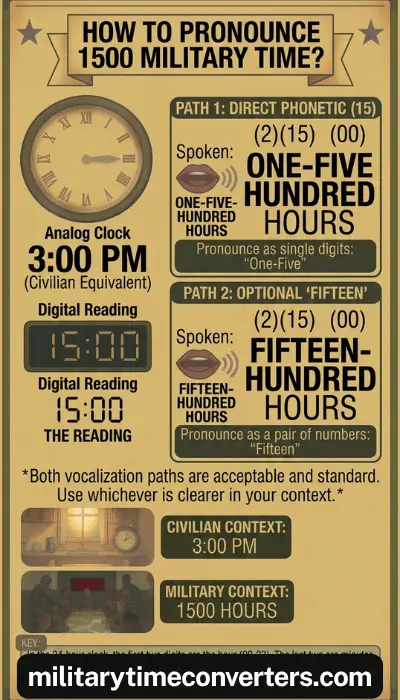
How to Pronounce 1500 Military Time?
- Say it as “fifteen hundred hours,” or just “fifteen hundred” once you’re comfortable dropping the formal ending.
- For 1530, that becomes “fifteen thirty hours,” with the minutes read as their own two-digit number.
- Paired with Zulu time, this hour is “fifteen hundred Zulu.”
“1500 in Zulu Time”
“1500Z” is this hour in Zulu time, the military’s version of UTC, fixed regardless of your local time zone. This matters constantly in aviation, where flight crews and ground control coordinate using this exact standard to avoid the kind of confusion that local time zones would otherwise create across a long international route.
Our military time zones guide breaks down the full letter-based system if you want to see how Zulu connects to every other zone on the clock.
Real-World Use: Training Wrap-Up and the Classic Duty Shift
For a lot of military units, 1500 is roughly when formal training wraps up for the day, a natural bookend to the classic 0700-to-1500 shift we covered back on the 0700 military time page. Eight hours after the workday started, this is where the day’s structured activity winds down and administrative time or personal time typically begins.
It’s a genuinely common civilian pattern too. Plenty of jobs that start early specifically to beat rush hour or take advantage of morning hours end up wrapping up right around this same 1500 mark. School dismissal times also tend to cluster somewhere near this hour, which means 1500 doubles as both a military and a civilian marker for “the structured part of the day is winding down.”
Real-World Use: Emergency Rooms and European Rail
Hospitals see a noticeable shift around this hour, emergency departments often experience rising patient volumes through the mid-to-late afternoon as people finish work and school and injuries or health concerns that built up during the day finally get addressed.
Across Europe, this hour also lines up with a genuine uptick in rail activity, commuter services begin ramping up as the afternoon progresses, and since European transit systems overwhelmingly run on the 24-hour clock by default, a departure board showing 15:00 is simply read as 3 PM without a second thought, no conversion required for anyone used to the format. It’s a small but telling reminder that outside the US, this whole numbering system isn’t a special “military” thing at all, it’s just how the clock works.
Conclusion
At this point, the conversion pattern should be easy to spot: 1500 military time is 3:00 PM, and 1530 is 3:30 PM. The key is to recognize that times from 1300 onward belong to the PM portion of the day, so you subtract 12 from the hour while leaving the minutes unchanged.
Keep going with 1600 military time, or head back to 1400 military time to review the hour before this one. And if you’d rather skip the math entirely, our military time converter on the homepage gets you the answer instantly.
Frequently Asked Questions
Summary