1100 Military Time: What is 11:00 AM in the 24-Hour Clock?
1100 military time is 11:00 AM. Twelfth hour of the day, and it comes with a bit of a milestone attached, this is the very last AM hour before the clock hits noon and the whole conversion pattern shifts.
We covered the leading-zero milestone back on the 1000 military time page, and this one sets up the next big shift, once you hit 1200, you’ll finally need to start adding and subtracting for the rest of the day. But we’re not there yet. Let’s cover exactly what 1100 means, how to say it, and where it shows up constantly.
Military Time → Standard Time
Type a 4-digit military time (e.g. 1830)
Minute-by-Minute Chart (1100 to 1159)
Here’s every minute inside this hour, including 1130.
| Military Time | Standard Time |
|---|---|
| 1100 | 11:00 AM |
| 1105 | 11:05 AM |
| 1110 | 11:10 AM |
| 1115 | 11:15 AM |
| 1120 | 11:20 AM |
| 1125 | 11:25 AM |
| 1130 | 11:30 AM |
| 1135 | 11:35 AM |
| 1140 | 11:40 AM |
| 1145 | 11:45 AM |
| 1150 | 11:50 AM |
| 1155 | 11:55 AM |
The hour holds at 11 throughout, and the minutes climb until the clock finally rolls over into 1200, noon.
What is 1100 Military Time?
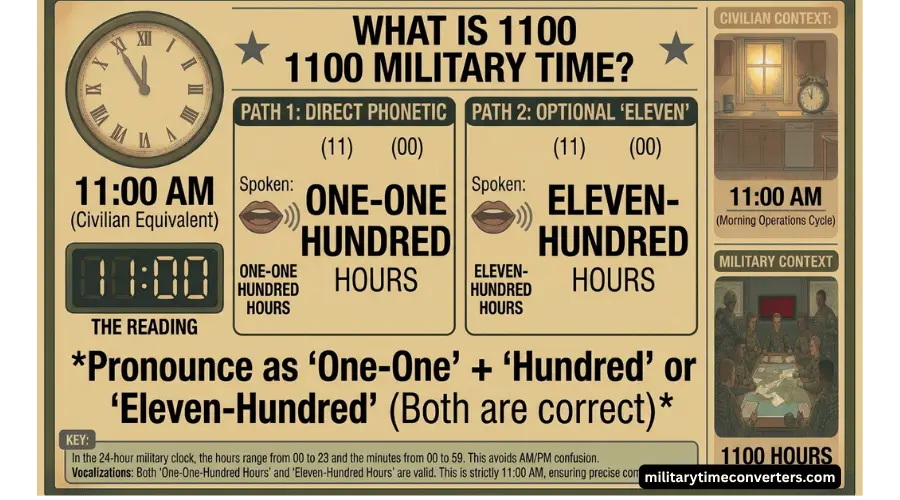
Split 1100 into two parts: “11” is the hour, “00” is the minutes. Morning conversions are still simple at this point, take the number, add a colon, and finish with AM. 1100 becomes 11:00, and since we’re still before noon, that’s 11:00 AM.
Enjoy the simplicity while it lasts, this is technically the final hour where military time and standard time line up this cleanly, with nothing more than a colon and an AM label separating the two.
What About 1130 Military Time?
1130 sits at the half-hour mark inside this hour, converting to 11:30 AM.
The hour stays fixed at 11, and the minutes simply move to 30, same pattern you’ve been using this whole way through the morning.
1100 vs 2300: Last Hour of the Morning, Last Hour of the Night
1100 and 2300 sit at opposite bookends of the day, but both read as “eleven o’clock,” which is where the confusion creeps in. The 2300 military time page walks through this pairing in full. Quick reminder here: this is one of the last spots in the day where reading the entire four-digit number actually matters this much.
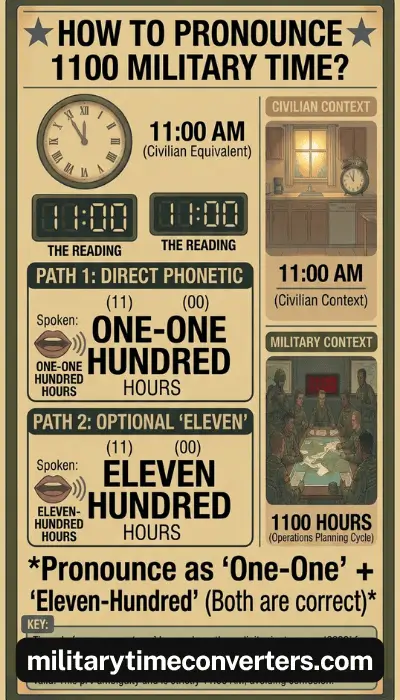
How to Pronounce 1100 Military Time?
- You’ll say this one as “eleven hundred hours.” Casually, that often just becomes “eleven hundred,” no “hours” needed in relaxed conversation.
- For 1130, you’d say “eleven thirty hours,” with the minutes read as their own two-digit number rather than folded into “hundred.”
- You may also hear this hour spoken digit by digit as “one-one-zero-zero hours” in radio communication, where breaking a number down that way removes any possibility of it being misheard.
“1100 in Zulu Time”
“1100Z” is this hour expressed in Zulu time, the military’s name for UTC. It doesn’t shift with local time zones, so 1100Z always points to the same fixed global moment no matter where you’re located.
This comes up constantly in international coordination, and it’s actually a meaningful cutoff point for cross-continental business too, since 1100 Eastern often lines up as roughly the last practical overlap window for calls between North America and Europe before the workday ends on one side. Our military time zones guide covers the full letter-based zone system if you want to understand how it all connects.
Real-World Use: Chow Time and the Brunch-to-Lunch Switch
On plenty of military bases, dining facilities open their doors for lunch somewhere between 1100 and 1130, giving this hour a strong association with “chow time” for anyone who’s spent time in that environment. It’s also a natural wrap-up point for anything that started earlier in the morning, meetings, training sessions, and briefings often close out right around here so people can break for lunch on schedule.
Restaurants follow a strikingly similar rhythm outside the military. Plenty of brunch spots stop serving their brunch menu at 1100 before switching over to lunch, making this hour a genuine transition point in food service scheduling, not just a military mealtime marker. If you want to get comfortable with how this kind of scheduling detail gets written correctly, our guide on how to write military time covers the formatting rules in full.
Real-World Use: Pre-Lunch Rush and Government Appointments
Coffee shops and quick-service restaurants often see a small rush build around 1100, as the pre-lunch crowd starts arriving before the bigger midday wave hits. Government healthcare systems lean on this hour too, appointment slots at facilities like the VA are frequently scheduled using the 24-hour format, and 1100 shows up often enough that it’s one of the more familiar times on those particular calendars.
If pronunciation across the different hours still feels inconsistent to you, our guide on how to read military time breaks the whole system down clearly, using examples just like this one.
Conclusion
1100 military time means 11:00 AM, making it the final hour of the morning in the 24-hour clock. The conversion is straightforward: 1100 → 11:00 AM, while 1130 → 11:30 AM. Unlike afternoon military times, there is no subtraction needed because 1100 is still before noon.
Ready for the next hour? 1200 military time is where the real conversion math kicks in, so it’s worth checking out next. Or head back to 1000 military time if you want to review the hour before this one. And if you’d rather skip the manual work, our military time converter on the homepage handles it instantly.
Frequently Asked Questions
Summary