What Does 1400 military time Mean on the 24-Hour Clock?
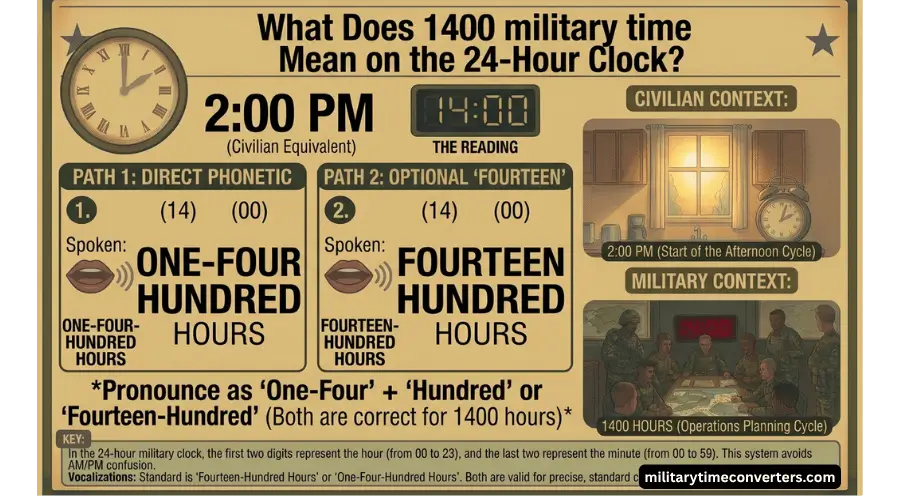
1400 military time is 2:00 PM. Fifteenth hour of the day, right in the middle of the afternoon, and by now the conversion should feel pretty familiar since we crossed into subtract-12 territory back at 1300.
Let’s run through the mechanics one more time, then get into how this hour actually gets used, from naval tradition to hospital shift changes.
Military Time → Standard Time
Type a 4-digit military time (e.g. 1830)
Minute-by-Minute Chart (1400 to 1459)
Here’s every minute inside this hour, including 1430.
| Military Time | Standard Time |
|---|---|
| 1400 | 2:00 PM |
| 1405 | 2:05 PM |
| 1410 | 2:10 PM |
| 1415 | 2:15 PM |
| 1420 | 2:20 PM |
| 1425 | 2:25 PM |
| 1430 | 2:30 PM |
| 1435 | 2:35 PM |
| 1440 | 2:40 PM |
| 1445 | 2:45 PM |
| 1450 | 2:50 PM |
| 1455 | 2:55 PM |
The hour holds at 14 throughout, minutes climbing until the clock rolls into 1500.
What is 1400 Military Time?
Subtract 12 from 14, and you get 2. Add a colon, tack on PM, and you land on 2:00 PM. That’s the whole process, and it’s the same rule you’ll use for every remaining hour of the day from here forward.
What About 1430 Military Time?
1430 military time is the half-hour mark inside this hour, 2:30 PM once you apply the same subtract-12 rule. The hour becomes 2, the minutes stay at 30, nothing more complicated than that.
Why 1400 and 0200 Get Confused?
Both hours technically represent “two o’clock,” and that overlap is exactly where people trip up. 0200 sits deep in the early morning, while 1400 lands squarely in mid-afternoon, twelve hours apart despite the shared digit.
The mistake tends to happen fastest when someone’s scanning a document quickly, a flight itinerary, a work schedule, a hospital chart, and their eye catches the “2” without registering the rest of the number. Since 1400 shows up constantly in daytime business hours, misreading it as 0200 (or the reverse) can genuinely throw off a meeting time or a shift start.
How to Tell 1400 and 0200 Apart at a Glance?
The fastest check: does the number look “too big” to be a normal clock hour? Anything at 1300 or above has already had 12 added to it, so 1400 is an immediate afternoon signal once that pattern clicks.
0200, on the other hand, always starts with a leading zero, a dead giveaway for the early morning hours. Our 0200 military time page covers this exact pairing from the other direction if you want the full picture from both sides.
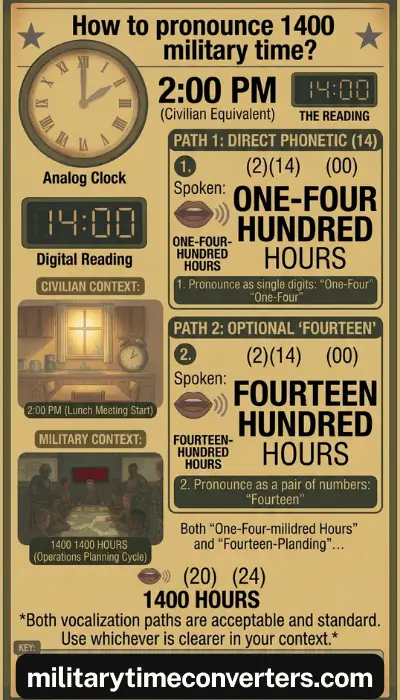
How to Pronounce 1400 Military Time?
- You’ll say this one as “fourteen hundred hours.” Drop the “hours” in casual speech and you get “fourteen hundred,” which is what most people actually say day to day.
- For 1430, that becomes “fourteen thirty hours,” minutes read as their own number rather than folded into “hundred.”
- Paired with Zulu time, this hour is spoken as “fourteen hundred Zulu.”
“1400 in Zulu Time”
“1400Z” is this hour in Zulu time, the military’s version of UTC, fixed no matter where you’re located. According to the Naval History and Heritage Command, the practice of dividing the day into standardized watch periods, with distinct names for each block of time, dates back centuries in naval tradition, part of the same lineage that eventually produced the standardized time zone system military and aviation crews rely on today.
Our military time zones guide picks up that thread and explains how the modern letter-based zones work.
Real-World Use: The Naval Afternoon Watch and Midday PT
In naval tradition, the hours from 1200 to 1600 are known as the afternoon watch, a block of time with its own name and its own place in a ship’s daily rhythm, long before anyone called this system “military time” at all. It’s a good reminder that a lot of the structure baked into this clock predates modern usage by a long way.
On land, 1400 shows up in a very different context, heat management. In hot climates, physical training sessions sometimes get scheduled around this hour specifically to sidestep the more brutal midday heat that peaks a couple hours earlier, trading a slightly less comfortable afternoon slot for meaningfully safer training conditions.
Real-World Use: Shift Handoffs and Afternoon Appointments
Hospitals and call centers frequently treat 1400 as a handoff window, the point where morning staff wrap up and afternoon teams take over. In healthcare specifically, this hour often lines up with a standard afternoon medication pass and vital sign check, a predictable checkpoint nurses build their afternoon rounds around. If you want to get comfortable writing these kinds of scheduling details correctly, our guide on how to write military time covers the exact formatting rules.
Government offices and public agencies lean on this hour too, frequently listing 1400 appointment slots on public-facing schedules. And if you’re coordinating internationally, plenty of countries default to the 24-hour clock for business scheduling entirely, so a meeting listed at 14:00 simply means 2:00 PM, no translation needed once you’re used to reading it.
Conclusion
1400 military time is 2:00 PM, and 1430 is 2:30 PM. The simplest way to understand this hour is to focus on the first two digits: 14 represents the hour, and because it is after noon, subtracting 12 gives you 2.
Keep going with 1500 military time, or head back to 1300 military time to review the hour before this one. And if you’d rather skip the math, our military time converter on the homepage handles it in one step.
Frequently Asked Questions
Summary