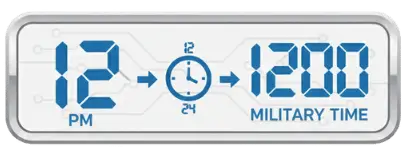
History of Military Time: From Ancient Egypt to the 24-Hour Clock
Military time is a lot older than the military itself. The 24-hour clock you use with our military time converter traces back more than 3,000 years, long before any army adopted it as standard.
This page walks through that full story, where the 24-hour day actually came from, and the specific dates each military force switched over to it. If you’re looking for the history of the zone-letter system or the NATO phonetic alphabet specifically, those have their own dedicated stories on our military time zones and NATO phonetic alphabet pages. This one is about the clock format itself.
Where the 24-Hour Day Actually Came From
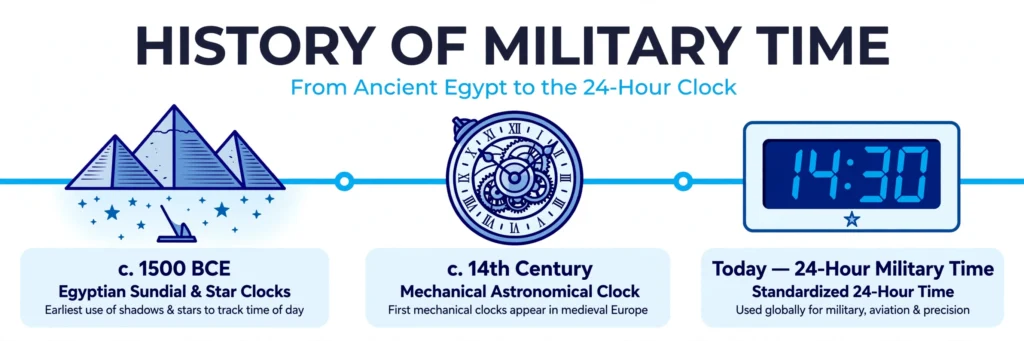
Long before anyone needed to coordinate a military operation, ancient Egyptian astronomers were already splitting the day into 24 parts, around 1500 BCE. They divided the night sky into 36 star clusters called decans, each rising roughly 40 minutes apart, and selected 12 of them to mark the nighttime hours. Mirroring that same division across daylight gave them 12 daytime hours and 12 nighttime hours, 24 in total.
Interestingly, the Egyptians didn’t choose 12 for any deep mathematical reason, they chose it because 12 divides evenly by 2, 3, 4, and 6, which made splitting the day into fractions much simpler than most other numbers would have allowed.

Early Mechanical Clocks Keep the Idea Alive
For centuries after Egypt, most civilizations, including the Greeks, Romans, and medieval Europeans, stuck with a 12-hour system in daily life, even as the 24-hour concept lived on in astronomy. One of the earliest physical devices to display a full 24-hour dial was the Prague Astronomical Clock, installed in 1410, still working today and still showing the same 24-hour concept the Egyptians first worked out thousands of years earlier.
When Did the Military Start Using 24-Hour Time?
The 24-hour clock sitting quietly in astronomy for thousands of years is one story. The military actually adopting it as an operational standard is a much more recent one, and it happened surprisingly fast once it started.
| Year | Event |
|---|---|
| ~1500 BCE | Ancient Egyptians establish the 24-hour day concept |
| 1410 | Prague Astronomical Clock installed with a full 24-hour dial |
| 1884 | International Meridian Conference establishes global time zones |
| 1915 | British Royal Navy adopts the 24-hour clock |
| 1918 | British Army adopts the 24-hour clock |
| 1920 | US Navy officially adopts the 24-hour clock |
| 1942 | US Army officially adopts the 24-hour clock |
| 1944 | ICAO is established, mandating 24-hour UTC time for international aviation |
| 1988 | ISO 8601 standardizes the 24-hour format internationally |
Why World War I Was the Turning Point
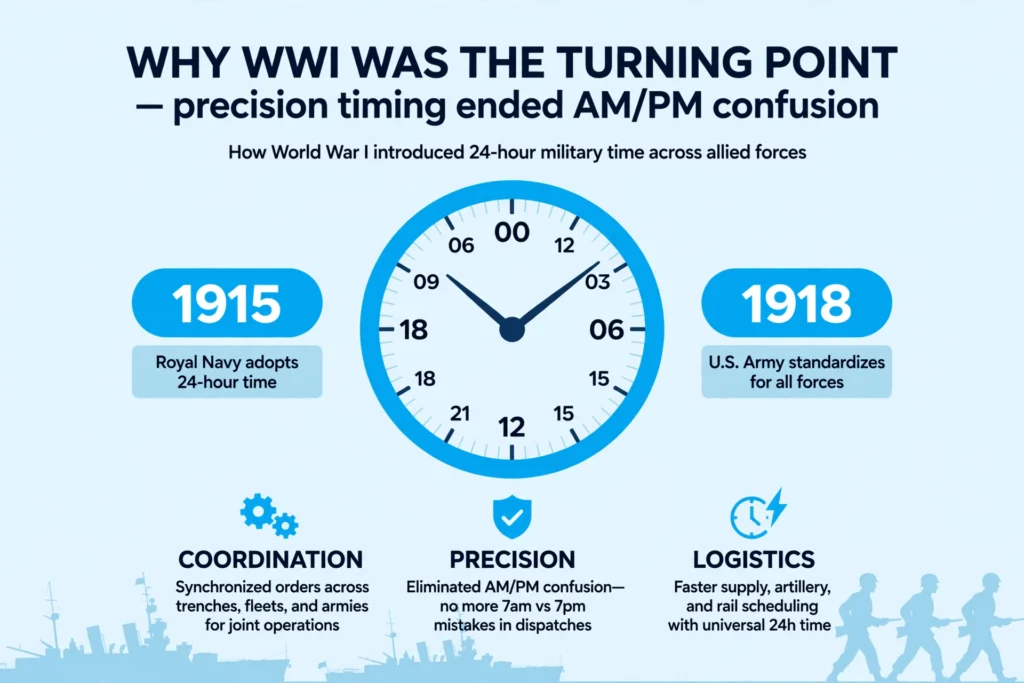
The British Royal Navy led the shift in 1915, with the British Army following in 1918, both decisions made in the middle of a war where coordinating attacks across multiple fronts depended on split-second timing. A miscommunication over whether an order meant 3 AM or 3 PM wasn’t a minor inconvenience in that context, it could mean a unit arriving twelve hours too late. The 24-hour clock removed that entire category of mistake in one move, which is exactly why military adoption accelerated so quickly once the war made the stakes impossible to ignore.
The US Military’s Slightly Slower Timeline
American forces followed a bit later than their British counterparts. The US Navy adopted the 24-hour system in 1920, two years after Britain had already made the switch, and the US Army didn’t officially follow until 1942, well into World War II. By the time that war ended, the 24-hour clock had become standard operating procedure across nearly every major military power in the world.
Why Is It Called “Military Time” Specifically?
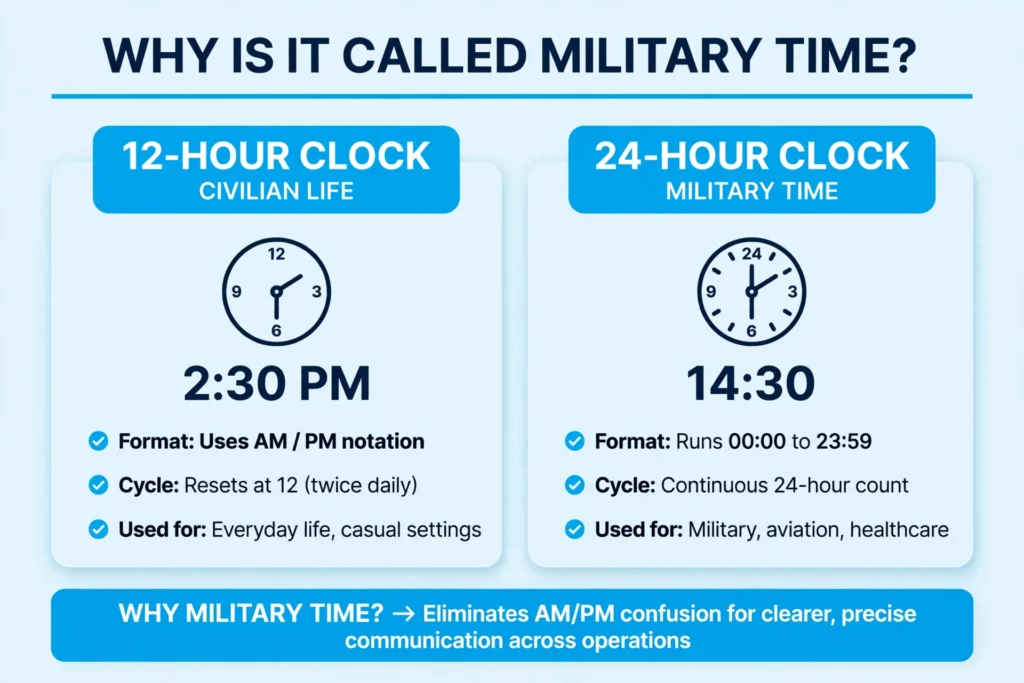
This is actually an American term more than anything else. In most of the world, the 24-hour format is simply called “the time,” full stop, no special name attached, since it’s the default way clocks and schedules are read in everyday civilian life. The phrase “military time” caught on specifically in the United States, where the 12-hour clock still dominates daily life, and the armed forces were the most visible, recognizable institution using the 24-hour alternative. The name stuck, even though plenty of non-military industries, aviation, healthcare, emergency services, use the exact same format today.
Beyond the Military: How the Format Spread
Once ICAO mandated 24-hour UTC time for international aviation in 1944, the format’s reach extended well past any single military. Our What is UTC guide covers how that same standard evolved into the atomic-clock-based system used worldwide today. By 1988, the International Organization for Standardization formally adopted ISO 8601, cementing the 24-hour clock as the international standard for representing dates and times in writing, the same standard still referenced in computing, aviation, and official documentation today.
Conclusion
The 24-hour clock didn’t start in a military briefing room, it started with Egyptian astronomers tracking stars more than 3,000 years before any army needed it. What the military did was prove the format’s real value under pressure, adopting it during the exact moments in history when a timing mistake carried the highest possible cost, and from there, it spread into aviation, healthcare, and daily life across most of the world.
For the modern side of this story, how the letter-based time zone system and the NATO phonetic alphabet fit into military communication today, see our military time zones and NATO phonetic alphabet guides, or convert a time instantly with our military time converter.