How to Write Military Time? | Quick Formatting Guide
You want to write military time, and knowing how to do that correctly matters because it makes your time entries clear and consistent. Using the right format avoids confusion and lets anyone reading your schedule know exactly what you mean. Use our Military Time Converter for easy conversion of military time.
Here’s the simple answer up front: when you write military time you convert the hour part (if needed) into the 24-hour system, you can also drop the colon between hours and minutes, you always use two digits for hours and two for minutes (for example “07” for seven in the morning), and you treat midnight as 0000 when you start the day.
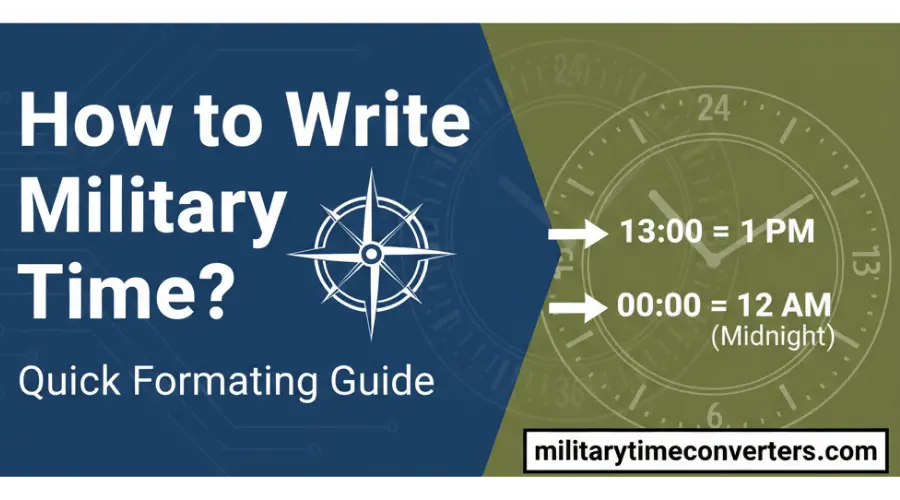
Quick Military Time Writing Guide:
Here is a comparison table so you can see how the standard 12-hour time converts into the properly written four-digit military time:
- If the number is between 0000 and 1159, it’s morning.
- If it’s 1200 or more, subtract 12 from the first two digits to get the afternoon or evening time.
Example:
1400 → 14 − 12 = 2:00 p.m.
0930 → stays as 9:30 a.m.
Simple, right? Let’s go deeper so it sticks forever. If you ever need a quick reminder on the number format, you can check my guide on how to read military time for a clear breakdown.
Military Time Conversion Table
Here’s a simple table you can use as a quick reference to write military time. It shows how military time lines up with standard (12-hour) time.
| Format Type | Example | How to Say It |
|---|---|---|
| Four-Digit Time | 1730 | HHMM (no colon) |
| With Minutes Only | 0905 | Hours + minutes |
| Midnight | 0000 | Start of day |
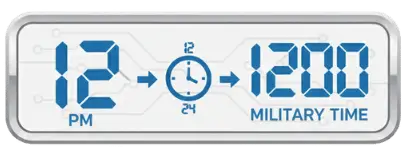
| Noon | 1200 | Midday |
| Single-Digit Hour | 0700 | Add leading zero |
| Exact Hour | 1500 | Ends with “00” |
| Written with Words | 1430 hours | Add “hours” (optional) |

How to convert and write it yourself?
Think of this as a guide you follow every time you need to write a time in the four‐digit military format.
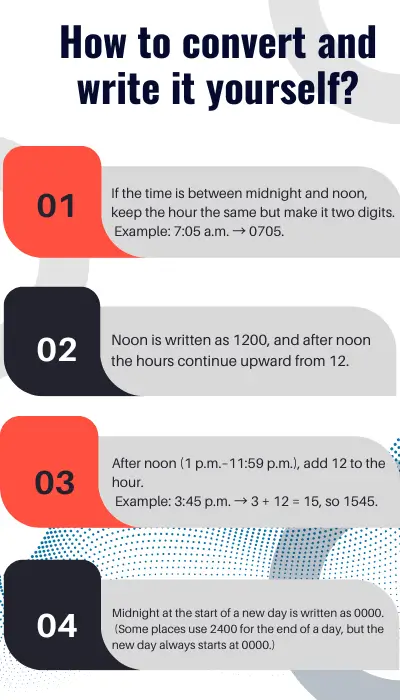
- First, if the time is in the early hours (midnight to just before noon) you keep the hour number largely the same, but you make sure it has two digits. For example if the hour is 7 and it’s 7:05 a.m., you write “07” for the hour, and then the minutes “05”, so it becomes 0705.
- Next, if the time is noon exactly, then that is written as 1200, since the hour is 12 and minutes 00, and after midday you switch into the higher numbers for hours.
- Then if the time is after noon (1:00 p.m. through 11:59 p.m.), you add 12 to the hour number so that you continue counting in the 24‐hour system. For example 3:45 p.m. → you take 3 + 12 = 15 for the hour, minutes “45”, so you write 1545.
- Finally, if it is midnight as the start of the day you write 0000 to show midnight (beginning of day). Some contexts might use 2400 to mark the end of a day, but for writing a time that starts a new day you use 0000.
Why this writing style matters?
You might ask why these exact writing rules exist. The main reason is clarity. When times are written in a consistent four‐digit form, with no “a.m./p.m.”, no colon, no ambiguity, everyone reading it knows exactly what you mean. This matters a lot in areas like scheduling, logistics, digital systems, transport timetables and other places where misreading a time can cause a problem.
Because you already understand the concept of military time and the 24‐hour clock, you just need this writing system. Once you follow it regularly you’ll find it becomes second nature and you will write military time accurately without thinking.
Common writing errors and how to avoid them
When you’re writing military time you’ll want to avoid a few pitfalls that trip people up.
One common error is forgetting the leading zero when the hour is less than 10. If you write “900” rather than “0900” for 9:00 a.m., the format isn’t consistent. So always ensure the hour has two digits: “09” not “9”.
Another mistake is mixing up noon and midnight. Remember noon is 1200 and midnight (start of day) is 0000. If someone writes “1200 a.m.” or “0000 p.m.” it will confuse the reader.
Also avoid using a colon, writing “hrs”, or adding “a.m./p.m.” after the four digits. In standard military writing you keep it simple and clean: four digits, nothing more.
Finally, when converting afternoon times make sure you do the math correctly when adding 12 hours. If it’s 7:39 p.m., then hour = 7 + 12 = 19, minutes = 39, so *1939*, not something like “719” or “7939”.
Simple conversion practice you can use
To build your confidence, work through some times in your head or on paper. Take a standard time, convert the hour if needed, ensure two digits for the hour, two for minutes, drop the colon. For example:
- 2:00 a.m. → you write 0200
- 8:20 p.m. → you add 12 to 8 so hour = 20, minutes = 20 → 2020
- 12:30 p.m. → noon + 30 minutes = 1230
- 12:01 a.m. → one minute after midnight, minute = 01, hour = 00 → 0001
Do this kind of quick conversion a few times and you lock in the pattern in your mind.
Friendly tips for you:
Here are a few friendly pieces of advice to help you write military time reliably each day:
- Make it a habit: whenever you note a time, write it in the four‐digit format right away.
- Always double-check your hour: if it’s afternoon, don’t forget to add 12.
- Always check you have two digits for minutes: “05” is okay, but “5” is not standard.
- When writing midnight or noon, don’t assume “12:00” with “a.m./p.m.” – use 0000 for the start of day, 1200 for noon.
- Keep your writing style consistent: if you’re saving times in a log, or sharing with others, use the same format throughout.
Final thoughts
Writing military time is easier than it seems because you just follow a few simple rules: use four digits, no colon, no a.m./p.m., add 12 to hours after noon, include leading zero when needed, and treat midnight as 0000. Once you practice it a few times, it becomes second nature and your time entries will be clear, professional and unambiguous.
Stick to the four‐digit system, check your conversions, and you’ll avoid the small mistakes that cause confusion. Go ahead and give it a try next time you enter a time in your schedule – you’ll get comfortable to write military time in no time.